
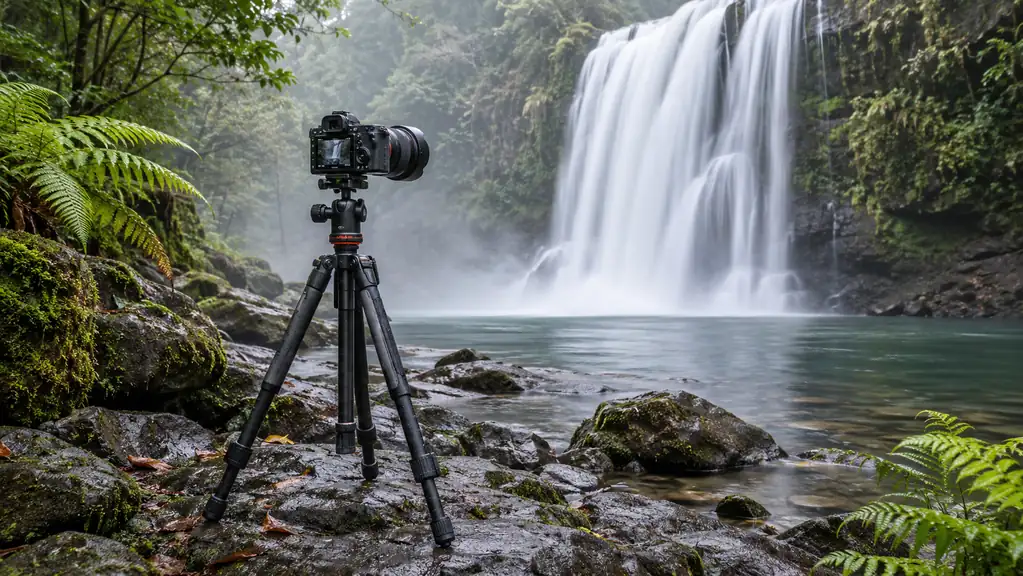
The first time I tried a long exposure at Rainbow Falls, I balanced my camera on a wet rock, held my breath, and got a photo that was almost sharp. Almost. For roughly two years that was my entire technique: rocks, railings, the hood of my car, and once a stack of library books on a picnic table. In March 2025 I bought the Neewer N55C, and my almost-sharp photos stopped being almost. It is a carbon fiber tripod that folds to 22.6 inches, weighs 1.6 kg, and reaches 168 centimeters at full height. I have carried it on muddy trails in the rain ever since.
Let me be clear about who is writing this. I am a dental office manager in Hilo, I have been shooting seriously for about twelve years, and I have never sold a photograph in my life. I shoot rainforest trails, waterfalls, tide pools, birds at my feeder, food at the Hilo Farmers Market, and my two cats whenever they wander into the frame. I am not going to recite a spec sheet at you. I am going to tell you what this Neewer tripod does on a wet Saturday, and where it genuinely annoys me.
The Quick Verdict
A genuinely light, genuinely tall carbon tripod that made long exposures possible for me. The ball head is the weak link if you shoot long lenses.
Amazon Check Today's Price →The tripod that ended my wet-rock balancing act
Carbon fiber, 1.6 kg, 168 centimeters at full height, folds to 22.6 inches. It is the one piece of gear that made my waterfall photos sharp.
Amazon Check Today's Price on Amazon →How I've Used It
My first real outing with it was a Saturday morning at Akaka Falls, in that fine mist that is not quite rain but soaks you anyway. I had my everyday zoom on the camera and a two second exposure in mind. I set the three legs, framed, tightened, and got the shot on the second try. What I remember is not the photo. It is that I stopped fighting my own equipment. Before the tripod, half of every waterfall shoot was spent solving a balance problem. After it, the work was just framing and light.
One Saturday last winter I shot Rainbow Falls in actual rain, not mist. I had a rain sleeve over the camera, a cloth over the head, and the tripod planted on the concrete pad at the overlook. Water ran down the legs and pooled around the collar where they meet. I shot eight frames at four seconds each, wiped everything down, and walked back to the car. That is the whole reason I quit bracing the camera on rocks. A rock does not let you take eight attempts at the same framing while the water keeps moving.
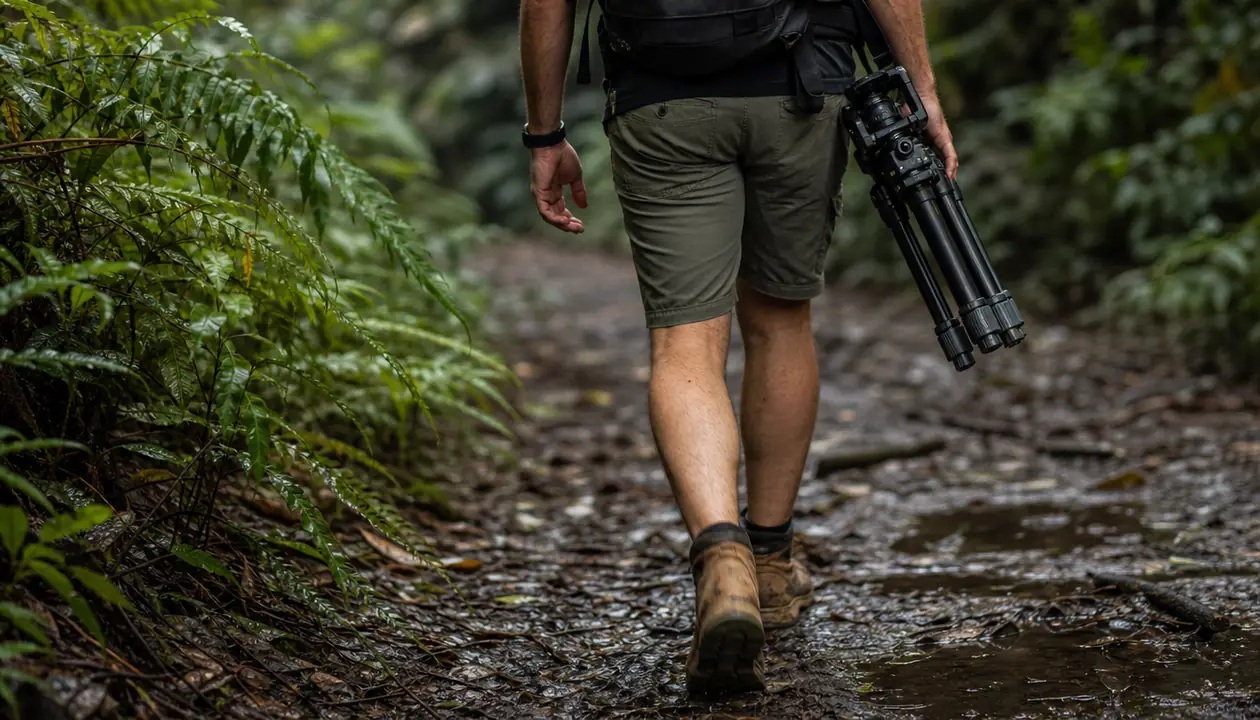
Since then the routine has not changed much. The tripod lives in the hall closet by the front door, and I carry it by hand or sling it over my shoulder. It does not fit in my sling bag, and I stopped pretending it might. On trail days it rides in the back seat of my small SUV, never loose, and I walk in with it over one shoulder while my bag stays on my back. That is a two item carry, which sounds minor until you have done it for a mile.
The work it actually does is long exposures, mostly. Moving water at the falls, wave wash at Onomea Bay, the blur of water sliding over lava rock in a tide pool. It also holds the camera still for the boring stuff: a timed shot of my husband and me on the lanai, a focus stack of a mushroom on a fallen log, a telephoto frame of a bird that will not sit still. Twenty months in, it has never once been the reason a photo failed.
What the Carbon Fiber Actually Buys You
Carbon fiber is the whole reason this tripod comes on hikes with me. At 1.6 kg the Neewer is light enough that I forget it is on my shoulder until I duck under a fallen fern. A friend at my camera club has an aluminum tripod of similar height, and lifting hers is a small shock every time. I have never owned aluminum, so I will not pretend to a long term comparison, but the difference on a two mile approach is not subtle. If you are strong and you shoot within fifty feet of your car, this matters much less.
Here is the thing I did not expect. Light gear gets used, and heavy gear gets left behind. The same friend with the aluminum tripod has a sturdier one in every measurable way, and it has stayed in her trunk on at least four outings we both went on, because carrying it up a muddy switchback sounded like less fun than leaving it. Mine came with me on all four. That is not something I can point to on a spec sheet. It is the entire practical argument for carbon fiber, and it took me a year of owning one to believe it.
The four leg sections are why it packs down to 22.6 inches. That number is the one I would check against your own bag, honestly. It is short enough to lie flat across a back seat and short enough to strap to the outside of a daypack. It is not short enough to disappear into a small sling. When I was shopping I actually took my sling bag, a tape measure, and a pencil to the kitchen table and wrote 22.6 on the side of it. That sounds silly. It saved me from ordering something I would have complained about for a year.
Full height is 168 centimeters, which for me at five foot six means I can stand up straight behind it and still have the camera at eye level. The lowest it goes is 57 centimeters. That is a real limitation, and I will come back to it. This is not a tripod you can splay on the ground for a low angle on a mushroom. For that I still lie down on the wet basalt and hold the camera, which is fine, because I am already wet.
The Ball Head and the Two Locks
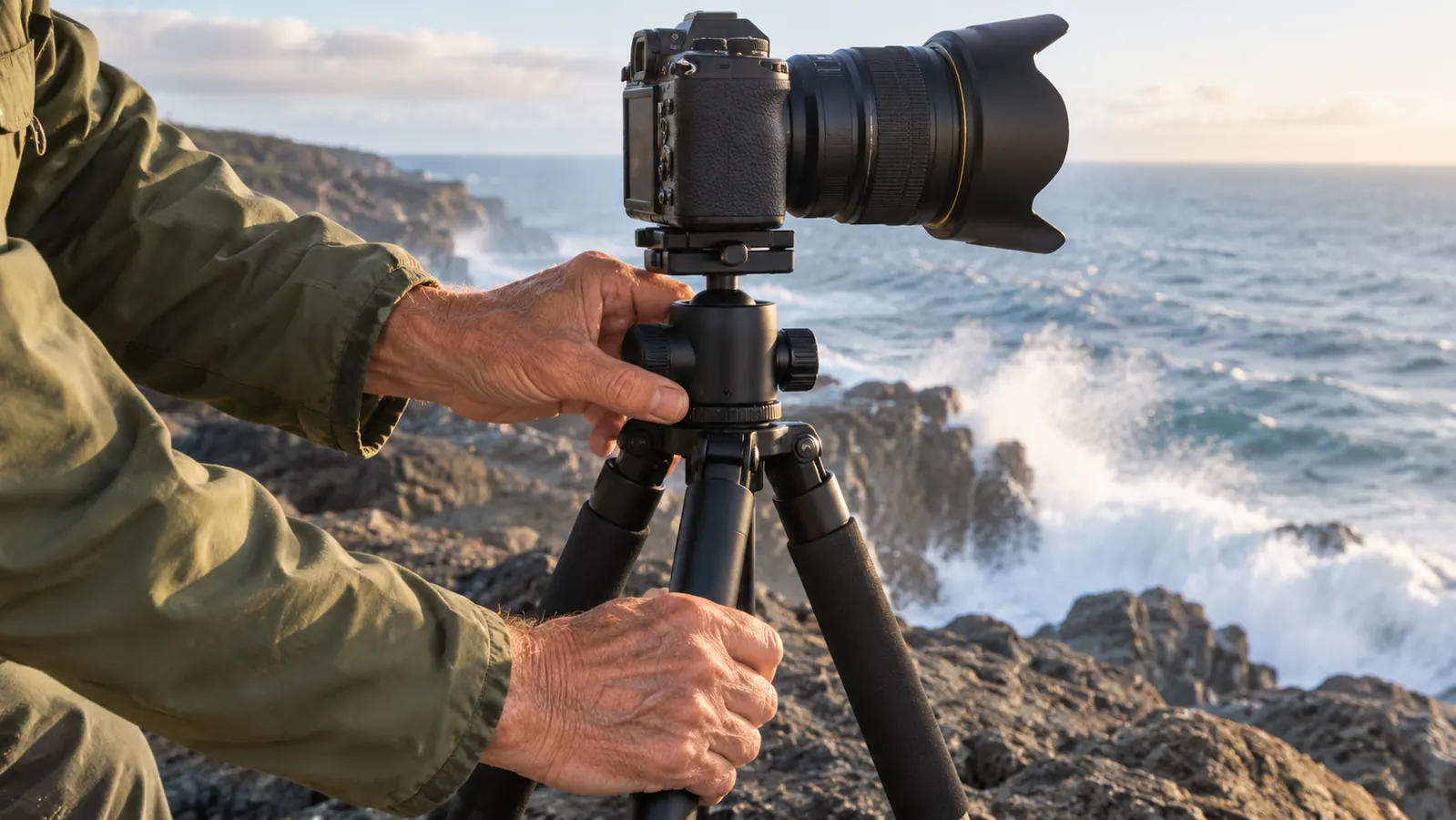
The head is a ball head with two locks and a 360 degree dial. In plain terms, one lock holds the camera exactly where I put it, and the dial lets me rotate the whole thing in steady increments between frames. I use the rotation for panning at Liliuokalani Gardens, where the light on the water changes fast and I want three overlapping frames before it goes. I use the ball lock for everything else, which is most things.
What I do with the dial, specifically: I find a framing I like, shoot it, rotate about fifteen degrees, shoot again, and again, until I have a sweep of the pond and the footbridge. Doing that by loosening a ball and re-aiming by eye is a miserable way to spend a morning, because you never know how far you moved. The dial takes the guessing out. I get three frames that overlap enough to stitch later, and I get them in the time it used to take me to line up one.
With my everyday zoom on the camera, the head is completely unremarkable, which is the highest compliment I can give a ball head. It holds, it releases smoothly, it holds again. With the telephoto racked all the way out, I have to be more deliberate. I frame, I tighten, I let go slowly, and I check the frame again. That is normal behavior for a compact ball head, and it is part of why I shoot birds on the monopod more often than not.
What it is not is a geared head. If you shoot architecture, or anything where you need to nudge the frame two degrees and know exactly where you landed, a ball head will drive you a little mad. I do not shoot architecture. I shoot water and birds and the occasional plate of food, and for those the speed of a ball head beats the precision of anything else I have tried.
Rain, Salt Spray, and the Limits I've Found
Hilo is wet. Not dramatic wet, just constant, the kind that fogs a lens the moment you step out of the car with the air conditioning still cold. I keep a rain sleeve in my bag for the camera and I wipe the tripod down with a cloth when I get home, then leave it out on the lanai to dry before it goes back in the closet. Twenty months of that and the leg locks still hold at full extension. That is the whole durability review, really. Nothing has loosened. Nothing has seized.
Onomea Bay on a gray Saturday is my least favorite place to be careless. The trail in is muddy, the roots are slick, and the ledge where everybody sets up looks dry until you put weight on it. I have a routine now. Tripod down, three points checked, camera on, strap still around my neck while I tighten the head. The strap loop is not paranoia. It is the one habit I picked up after watching a photographer at that same ledge fumble a camera body off a ball head. It is slower by about ten seconds, and I have not had a scare since.
Wet basalt is the real test and the one I actually care about. The rocks at Onomea Bay are slick in a way that makes you reconsider your life choices, and I have set this tripod down on them dozens of times. It has not slid. I cannot tell you whether that is the leg tips, the weight, or plain luck, and I am not going to claim more than I know. What I do know is that I no longer brace the camera on a rock, and I no longer come home with a card full of almost.
Salt is the other thing. I rinse the lower legs with fresh water after a coastline morning and dry them before they go back in the closet. I do not treat this as a sealed piece of gear and I would not encourage you to. It is a tripod that lives in a humid house and gets rained on, and the maintenance it asks for is a cloth and two minutes.
The Monopod Trick I Use More Than Expected
One leg unscrews and becomes a monopod. I assumed that was a marketing line until the first Saturday I used it at the farmers market. I took the leg off, set the camera on it, and spent an hour working a plate of malasadas and a woman selling orchids with something steady in one hand and nothing to set down. In a crowd, that is worth more than the tripod itself.
I use it more than I expected, mostly for the telephoto at my own bird feeder on the lanai, where there is no room for three legs and no time to set them anyway. The monopod steadies the lens enough that I can shoot at a slower shutter than I would hand held, and I can shift it a foot to the left without picking up a whole tripod. It is the part of this design I would miss most if I lost it.
What I Liked
- 1.6 kg of carbon fiber, so it actually leaves the house with me
- Folds to 22.6 inches and reaches 168 centimeters at full height
- The 360 degree dial makes panning for overlapping frames quick
- One leg converts to a monopod I now use at the market and the bird feeder
- Ships with a portable bag and a one year manufacturer warranty
Where It Falls Short
- The lowest it goes is 57 centimeters, so no ground level shots
- A ball head is fast but not precise when you need tiny framing nudges
- With the telephoto fully extended I have to tighten, release, and recheck
- 22.6 inches folded still does not fit in a small sling bag
Twenty months of Hilo rain and the leg locks still hold at full extension. That is the whole durability review, really.
Who This Is For
This is for the hobby photographer who keeps losing sharpness to a camera that moved a millimeter. If you shoot waterfalls, coastlines, night skies, food, or anything else that needs a long exposure, and you have been propping the camera on whatever is handy, this is the upgrade that changes your hit rate. It is also for anyone who hikes to shoot and refuses to carry something heavy. At 1.6 kg, mine goes on trails I would not drag a cheap tripod up.
It suits mirrorless shooters with modest lenses best. My everyday zoom and this head are a happy pairing, and I suspect most people reading this are in the same spot. It also suits anyone who shoots alone in public, because it sets up in about thirty seconds and does not draw a crowd the way a big studio rig does.
Who Should Skip It
Skip it if you need to get the camera to the ground. Fifty seven centimeters is the floor here, and no amount of wishing changes that. Skip it if you shoot a long telephoto for a living, because a compact ball head will make you work harder than a heavier head would. Skip it if you shoot architecture or interiors where you need to nudge a frame by degrees and know exactly where it lands.
And skip it if you want one tripod for everything, including studio work and video panning. That is a different tool with a different head, and buying this one to do that job will leave you frustrated with a piece of gear that is genuinely good at the job it was built for.
Twenty months later, I would buy the same tripod again
If your photos are almost sharp, the fix is usually not a new lens. It is something that holds the camera still while the water moves.
Amazon Check Today's Price on Amazon →