
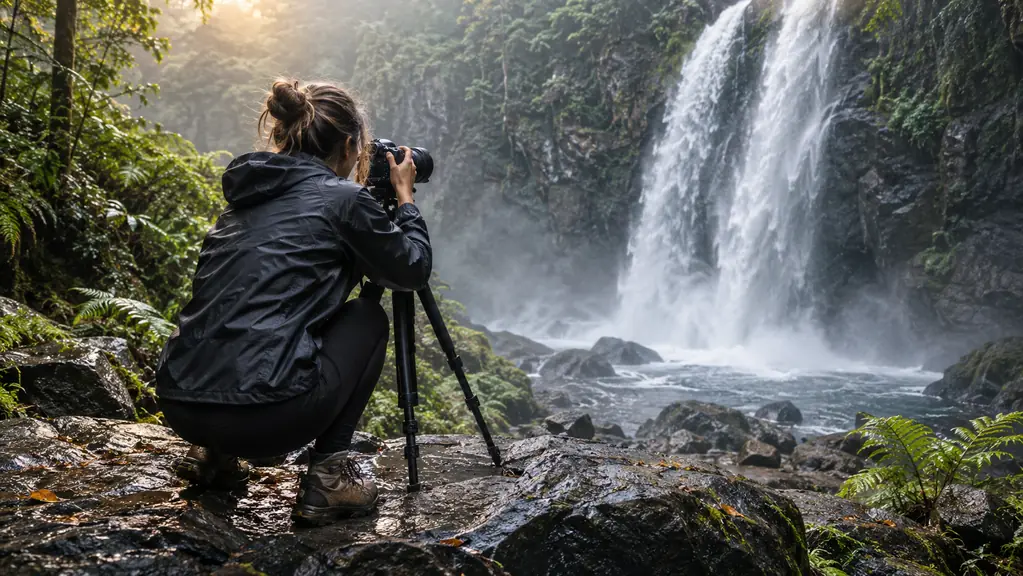
Every waterfall photo I took in my first year at Rainbow Falls came out looking like someone had breathed on the lens. The water was a soft white smear, which was the point, but the ferns behind it were soft too, and the rocks had a shimmer I could not explain. I blamed the humidity. I blamed my grip. It took a wet Saturday and a borrowed railing to show me the real problem, which was my hands, and the fact that I kept asking them to do something they cannot do.
I bought the Neewer N55C carbon fiber tripod in March 2025. It is the first tripod I have ever owned and, about 20 months later, still the only one. It lives in the hall closet, rides in the back seat of my small SUV, and gets carried over my shoulder on its strap because it does not fit in my sling bag. Here are ten things it actually changed, roughly in the order I noticed them.
The difference between a blurry waterfall and a deliberate one
The Neewer N55C is a 66 inch carbon fiber tripod with a ball head that locks down and a leg that unscrews into a monopod. It is the piece of gear I reach for before sunrise at Rainbow Falls.
Amazon See today's price on Amazon →Two-second exposures stop being a coin flip
Handheld, I could manage maybe a quarter second before the shake showed up in the frame. A two-second exposure at Akaka Falls turns falling water into a smooth white ribbon, and on a tripod that result is repeatable. I press the shutter, count to two, and the next frame looks like the last one. That repeatability is the whole thing. It means I can change one variable at a time and actually learn from what comes back on the card. My first real test was a Saturday in April 2025 at the overlook above Rainbow Falls, in flat grey light with rain coming down in sheets. I shot the same frame four times in a row and all four matched on the back screen. I had never had that happen before, and I stood there in the rain grinning like a fool.
The 360 degree dial lets me re-level without starting over
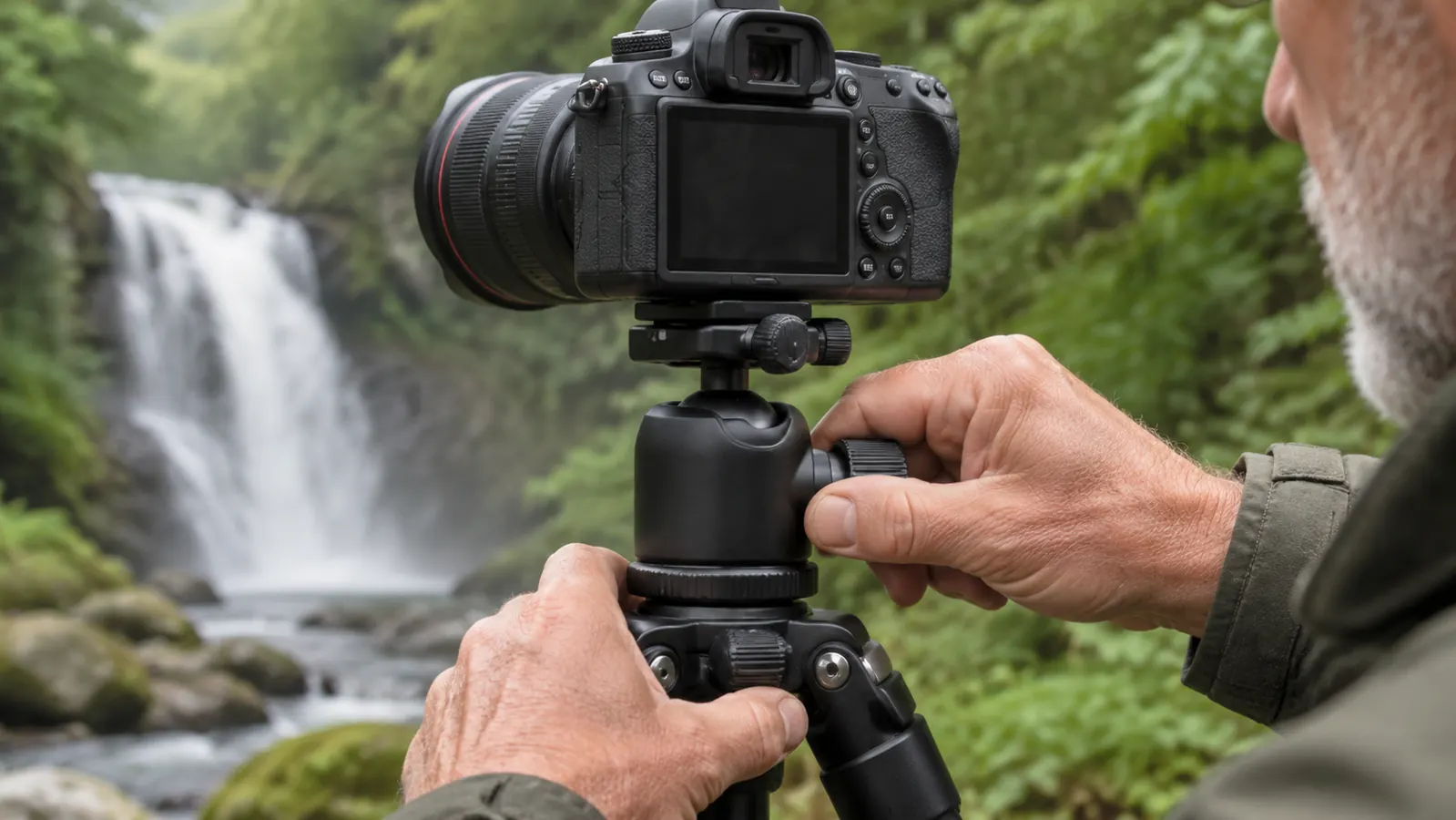
The ball head has two locks and a 360 degree dial. When I am on a slope and want to swing the camera to a new angle, I loosen the pan lock, move it, and the horizon stays where I put it. Before this I was the person straightening every waterfall photo by two degrees in editing, on every single frame, forever. Now I rarely touch the crop.
It drops to 57 cm, which is where tide pools live
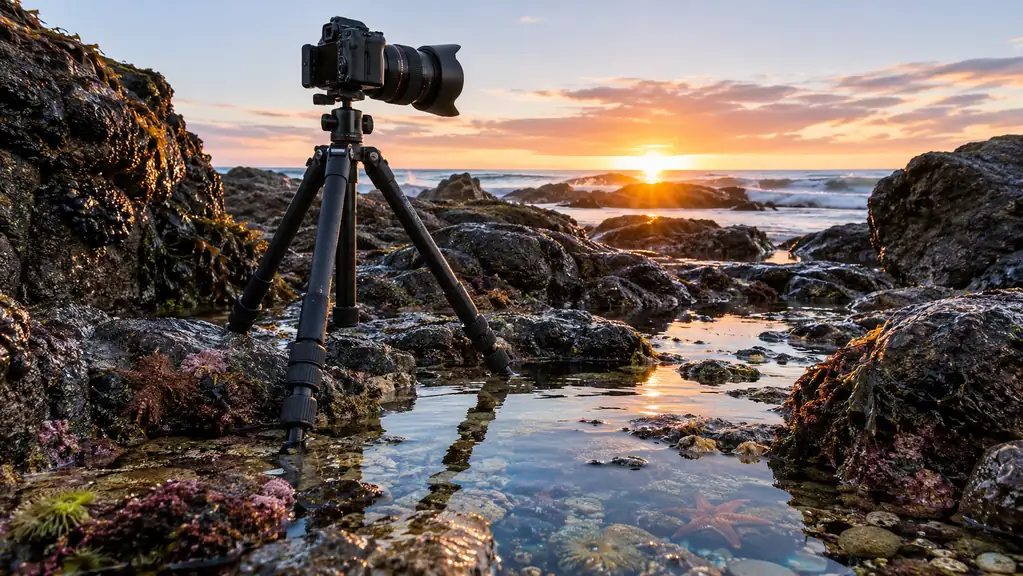
The minimum height is 57 centimeters. At Onomea Bay that is almost exactly the height of a good tide pool frame, low enough to see down into the water without lying on wet rock and ruining a Saturday. Because there are four leg sections, I can splay the legs unevenly across cracked lava and still have the head sitting level. Before the tripod I tried kneeling on a folded rain sleeve, which worked right up until the rock shifted and I put a hand down in six inches of cold water. At 57 centimeters the camera sits just above the surface, and I stay upright and dry.
1.6 kg is the number that decides whether it leaves the closet
The tripod weighs 1.6 kilograms. That is light enough that I stopped negotiating with myself about whether to bring it. Carbon fiber is the reason. A heavier tripod is not a worse tripod, it is just one I would leave in the car, and a tripod in the car has never sharpened a single photograph in the history of the medium.
Four leg sections handle lava rock and a step of tree root
Rainforest trails on this side of the island are not flat. I have set this up on a step of root at Akaka Falls and on broken lava at the coast. Adjusting one section at a time means I can run one leg short and one long and still have a level head. On wet ground, being able to work one leg at a time is worth more than any spec on the box. There is one root step on the trail in, maybe eight inches of drop across the width of a hiking boot, where I shoot the lower falls. Two legs go short, one stays long, and the head comes out level on the first try now instead of the fifth.
The monopod leg saves my arms at the bird feeder
One leg unscrews and becomes a monopod. With the 70-300mm on and a bird moving through the branches, a monopod is faster to set than three legs and steadier than my elbows will ever be. I use it on the lanai more than anywhere else, usually while my coffee goes cold beside me.
It carries over my shoulder on a wet trail
This tripod does not fit in my sling bag, so it rides over my shoulder on its strap or in my hand. That sounds like a drawback and mostly is not. I can set it down, shoot, and move on without opening anything. On the muddy stretch above Rainbow Falls, not having to unzip a bag in the rain is the entire game.
Locked down, the shooting gets quiet
Once the camera is on the tripod, the pace changes. Frame, focus, trip the shutter, wait. I take fewer frames and keep more of them, because I am not spraying and hoping. My last Saturday morning at Onomea Bay produced eleven photos I kept, which for me is a genuinely good morning and not a number I hit often. Handheld on that same stretch of coastline I would come home with a couple hundred frames and keep four, all of them a little soft in the corners.
The included bag keeps wet gear off the back seat
The tripod comes with a portable bag. Mine lives in that bag in the hall closet when it is dry, and goes into the back seat floor well when it is not. Beads of rain, a little sand, one leaf that came home from Akaka Falls. The bag takes all of it, and the upholstery in my small SUV has stayed clean for 20 months.
A one year manufacturer warranty I have not needed
There is a one year manufacturer warranty on the Neewer tripod. In 20 months of hauling it through rainforest and along the coast, I have not used it. The head still locks, the legs still hold where I set them, and the one thing that worked loose took a half turn to fix. That is not a dramatic endorsement. It is just what a piece of gear is supposed to do.
What I'd Skip
What I would skip is the idea that you need the tallest tripod in the store. This one extends to 168 centimeters and I almost never use it above chest height. Wind catches a tall tripod, and at Rainbow Falls the wind comes off the water in gusts that will find anything loose. Most of my keepers are shot with the legs well below full extension, where the whole thing is stiffer and the camera is closer to the ground. I would also skip buying a second tripod before you have worn out the first. Mine is 20 months in and I have no reason to go looking.
A tripod in the car has never sharpened a single photograph.
If your waterfalls are soft, check the support before the lens
I spent a year blaming a lens for a problem that was in my hands. The Neewer N55C is the piece of gear that made me stop straightening horizons in editing, and the one I still carry over my shoulder on a wet Saturday.
Amazon Check today's price on Amazon →