
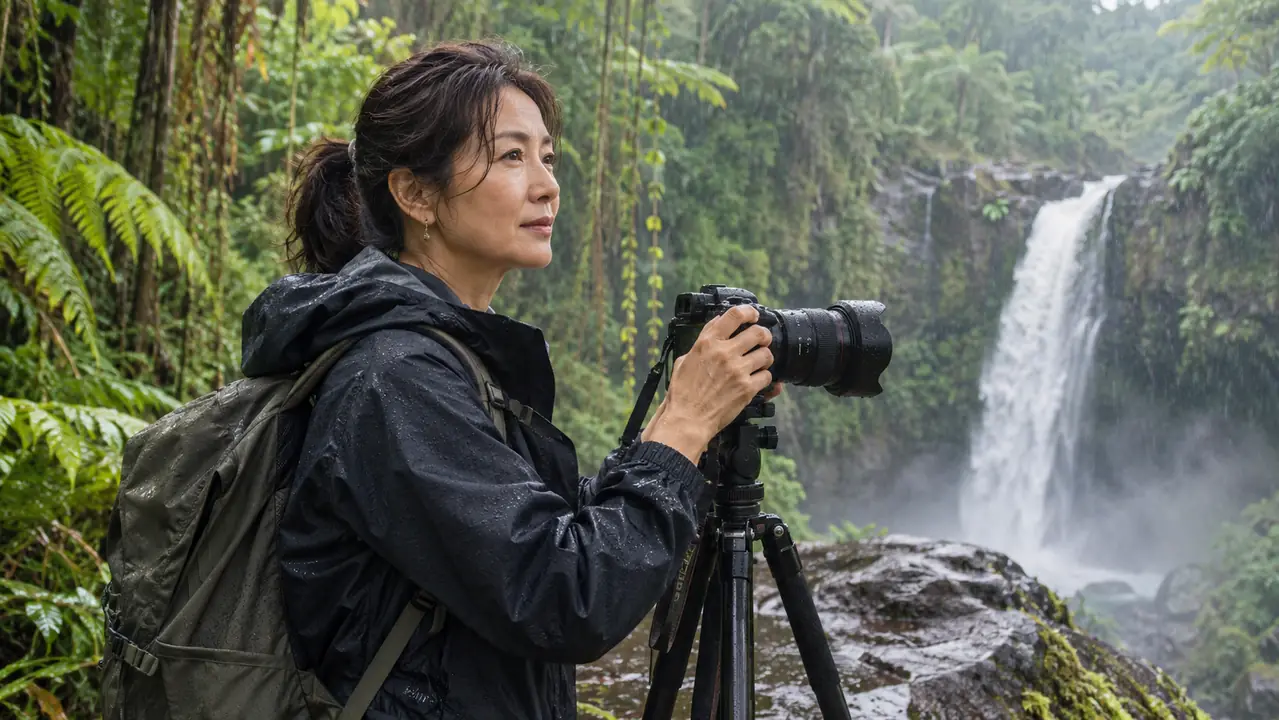
I bought my first tripod in March 2025, at forty-four years old, after twelve years of taking photographs. That is not a typo. For more than a decade I shot waterfalls by wedging my camera into a lava rock crevice and hoping. I balanced it on the railing at Liliuokalani Gardens. Once, at Onomea Bay, I laid it flat on a driftwood log and held my breath while the shutter stayed open for two full seconds.
It worked about half the time. The other half I came home with soft frames and a stiff neck. What finally pushed me was a wet Saturday in January, at Rainbow Falls, watching a woman my age casually screw a tripod into the mud, level it, and take the exact shot I had been failing at for years. The tripod was a Neewer N55C. I ordered one that week.
Eleven years of bracing my camera on rocks, and the fix was a carbon fiber column I could carry over one shoulder without thinking about it.
What Twenty Months of Real Use Looks Like
I have now carried the Neewer N55C to Rainbow Falls more times than I can count, up the steps at Akaka Falls, across the rocks at Onomea Bay, and around the tide pools early on Saturday mornings. It lives in the hall closet by the door. I carry it by hand or sling it over my shoulder on its strap because it does not fit in my sling bag, which is fine, because the whole point of the thing is that carrying it is not a chore.
The folded length is 22.6 inches. The weight is 1.6 kilograms, which in my hiking terms means I notice it for the first five minutes and then I stop noticing it. It is carbon fiber, and that is the reason I chose it over anything heavier: on the windward side we are always walking in wet air, and the walk in is usually longer than the shooting.
The legs have four sections, so it collapses small enough to sit in the back of the SUV without sliding around. Minimum height is 57 centimeters, which matters more than I expected, because at the tide pools I often want the camera down low and close to the water rather than up at my eye level. I have used that low setting more than I have used the full height.
The head is a ball head with two locks and a 360 degree dial. I want to be honest here: the first month, I over-loosened both locks at once and had a scary moment with my camera. Then I learned the order, one lock to set the general direction, the other to fine-tune, and it became quick. I can now go from bag to level in well under a minute, which is the whole game when the light is changing and the rain is deciding what it wants to do.
One leg unscrews and becomes a monopod. I did not think I would use that and I mostly do not, but on a windy morning at the coastline it was handy to have a single column to brace against the railing while I waited out a gust.
The tripod I wish I had bought eleven years ago
Carbon fiber, 22.6 inches folded, 1.6 kilograms, a ball head with a 360 degree dial, and one leg that works as a monopod. It comes with a carry bag. My Neewer N55C has been rained on for twenty months and still levels clean.
Amazon Check Today's Price on Amazon →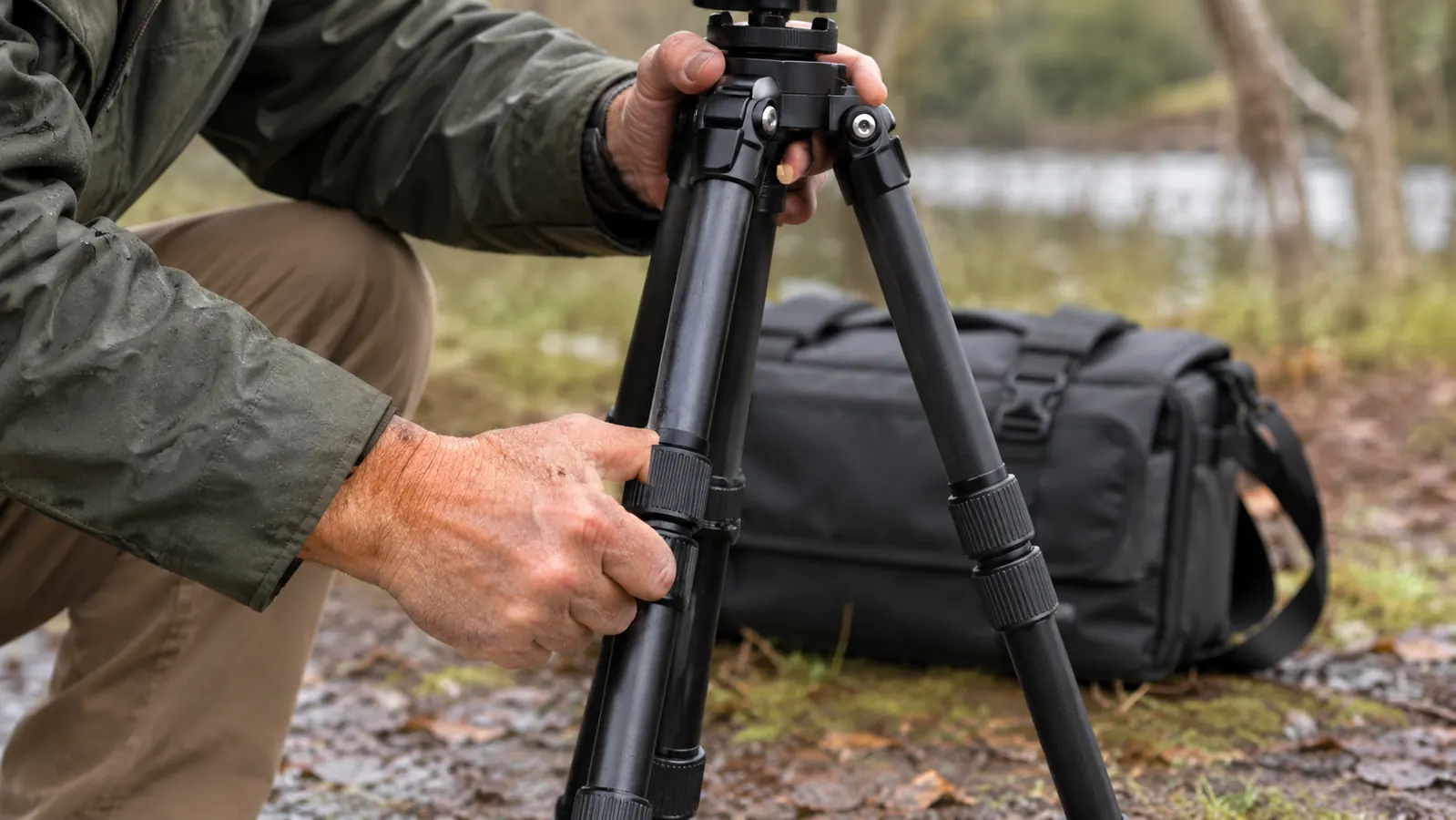
The Part That Actually Changed My Photos
Here is the thing nobody tells you when you are starting out. A tripod does not make you a better photographer. It removes a whole category of decisions. Before, every low-light frame was a negotiation: how high can I push the ISO before the grain gets ugly, how slow can the shutter go before my hands betray me. Now I set the shutter speed I want and stop thinking. My waterfall shots went from about one keeper in ten to about one in three, and the keepers are sharper than anything I ever got hand-held.
My cats, Pika and Mochi, are the other place it earns its keep. Mochi is black and shy and I have spent years failing to expose her properly in the window light. With the camera locked down I can take six frames at slightly different settings and pick the one that actually holds her fur instead of turning her into a silhouette.
There are honest drawbacks. The Neewer N55C is not a light little travel tripod you forget about, and if I am hiking a long way in I feel the 1.6 kilograms by the end. The ball head took practice. And I would not call it a quick-grab tool for street shooting, because setting up three legs is never going to be as fast as lifting the camera to your eye. If you want a nearly weightless thing for a long backpacking trip, this is more tripod than you need.
What I'd Tell You If We Were Sitting at My Kitchen Table
I would tell you that I waited far too long because I thought a tripod was for professionals with better cameras than mine. That was backwards. It is the single cheapest upgrade to the sharpness of your photographs, and it does not care what body you screw onto it.
I would tell you to buy carbon fiber if you are going to carry the thing on trails, because the tripod you leave in the car is a tripod you do not own. That is how I ended up with the Neewer N55C rather than a cheaper heavier one. I would tell you to practice with the ball head in your living room before you take it somewhere with spray in the air. And I would tell you that if you shoot waterfalls, tide pools or the coast here on the windward side, this is the purchase that stops you from bracing your camera on a rock and praying.
Twenty months in, mine has been rained on, dropped in mud, and used as a walking aid on a slippery step at Akaka Falls. It still folds, still locks, still levels. I am not gentle with gear and the Neewer N55C has not given me a reason to complain.
Go take the shot you keep failing at
Mine was the Rainbow Falls frame I could never hold still for. Twenty months of use later, it is the piece of gear I reach for most. One year manufacturer warranty, and a carry bag in the box.
Amazon Check Today's Price on Amazon →