
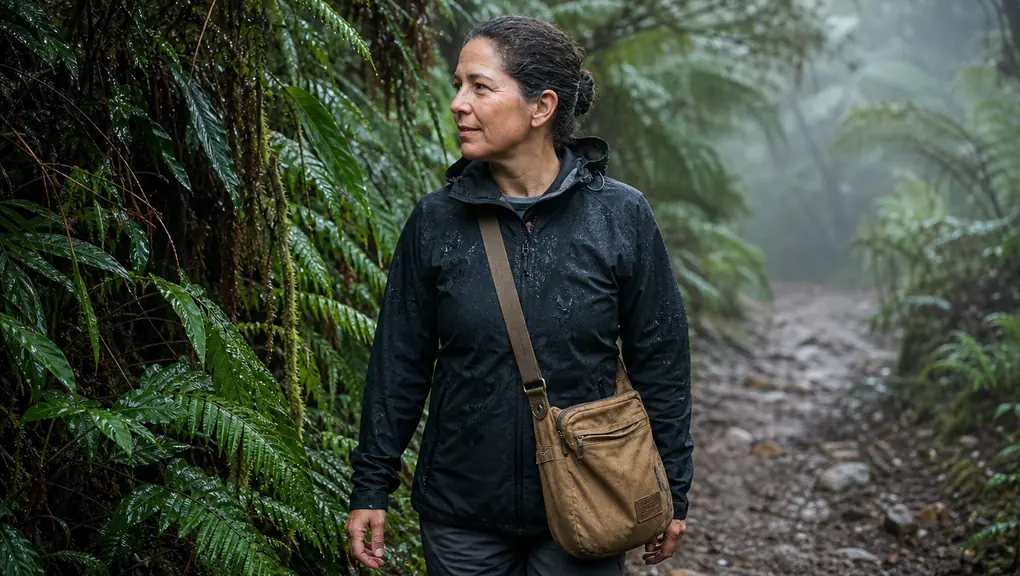
Three miles into the Onomea Bay trail the rain turned sideways. I had one hand on a tree root and the other clamped on a hiking daypack that had become the entire problem. My camera was inside that pack, wrapped in a dish towel like a casserole on its way to a potluck. Every time I wanted a frame I had to stop, set the pack down in the mud, unwrap, shoot, rewrap, hoist, and keep walking. By the time I reached the overlook the light had gone flat and my knees were brown. That walk is why I went looking, and in June 2025 I bought the K&F Concept Camera Sling Bag.
Seventeen months on, it has been to Rainbow Falls more times than I can count, up the Akaka Falls loop, out on the rocks at Onomea Bay, through Liliuokalani Gardens on a gray morning, and to the Hilo Farmers Market most Saturdays. It has also sat on my kitchen table while I photographed a plate of food before it went cold. Here is what it carries, how it has held up in Hilo weather, and where it still gets on my nerves.
The Quick Verdict
A light, quick sling that made me actually carry my camera instead of leaving it in the SUV. Just do not ask it to swallow a full kit.
Amazon Check Today's Price →Get the camera off your back and onto your hip
One body, two lenses, and a bag that swings around to your chest instead of going down in the mud. Mine has 17 months of Big Island rain on it.
Amazon Check Today's Price on Amazon →How I've Used It
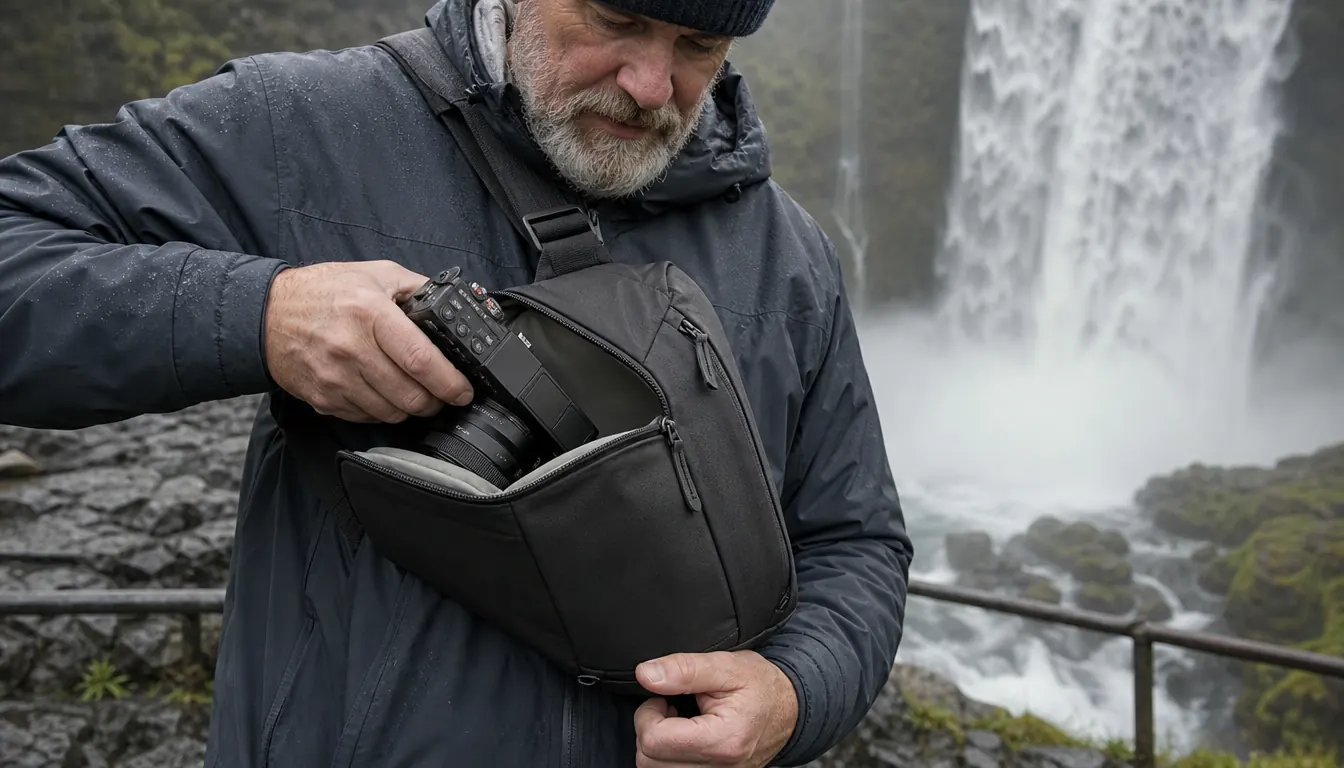
My routine is unglamorous. I work out Monday, Wednesday and Friday mornings, I read on the lanai when the rain lets up, and I shoot on Saturdays. The sling is the bag I grab for those Saturdays, and the reason is one motion. With it worn across my body, I rotate the whole bag around my waist and the main compartment opens flat against my chest at chest height. I never set it down. On a wet trail that is not a small thing. A backpack has to come off your shoulders and go on the ground, and on this island the ground is usually mud.
A typical Saturday looks like this. I leave the house around seven, drive to the Hilo Farmers Market, and park a few blocks away. The bag rides on my hip through the stalls. When I want a shot of a mango display I rotate it around, unzip, lift the camera out, shoot, and put it back without stopping the conversation with the vendor. Then I drive over to Liliuokalani Gardens and walk the paths for an hour, mostly looking for the herons and the tide line. On the way home the bag rides on the back seat of the SUV, upright, because the shell is soft and I am not putting a bag of groceries on top of it. That is the whole routine, and it stuck because nothing in it takes two hands and a flat surface.
I timed the motion once, out of curiosity, with the stopwatch on my phone. Camera in the bag to camera at my eye, about six seconds. With the daypack and the dish towel it was closer to forty, and that was standing still on dry ground. Six seconds means I take shots I used to skip, and that is the entire case for this bag in one number.
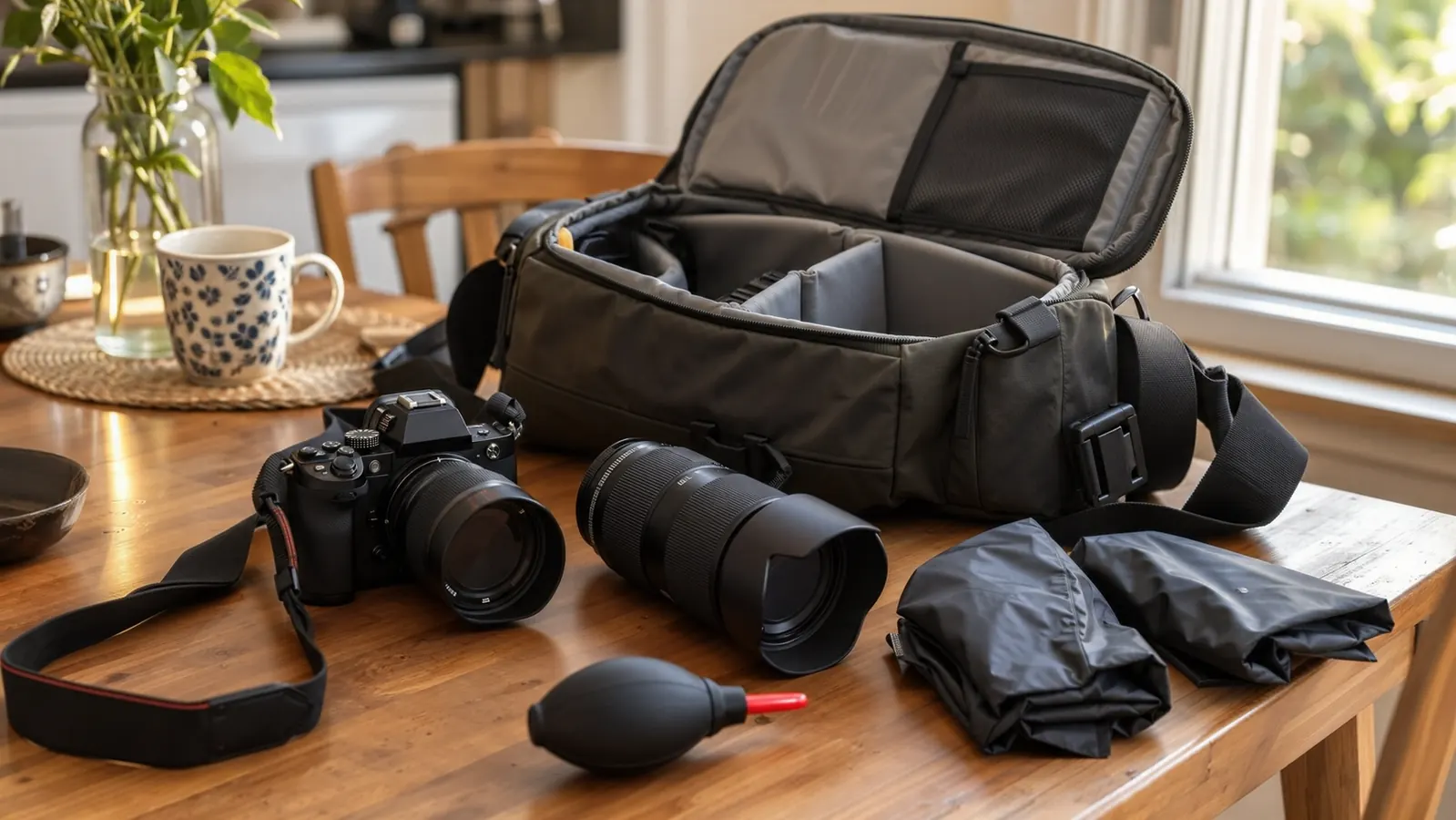
What rides in it: my camera body with the 24-105mm zoom mounted, the 70-300mm on the other side of the divider, both rain sleeves folded into the front pocket, the blower and one microfiber cloth from my cleaning kit in a small interior pocket, keys, and a bag of trail mix. That is a full load, and I want to be clear that it is the edge of what this bag wants to do.
The strap adjusts over a wide range, starting around 34 inches at its shortest, and I wear mine so the bag sits just above my hip. The web handle on top is useful for lifting it off the back seat of the SUV without dragging it by the strap. After a full morning of walking I notice the weight, and I have never once thought about leaving the telephoto at home to lighten it.
What Actually Fits, and What Does Not
The numbers, straight from the listing, because they matter more than any adjective. External size is 13 by 8.6 by 5.9 inches. Internal size is 10.6 by 6.7 by 4.1 inches. Capacity is listed at 10 liters and the bag itself weighs 600 grams, a little over a pound before you put anything in it. K&F Concept says it holds one camera and two lenses, and it ships with a single flexfold divider.
That single divider is the whole layout. One side gets the body with the everyday zoom mounted, the other side gets the telephoto. The divider is padded and stiff enough that the two do not knock together while I am scrambling over roots. The shell is soft, which means the bag protects against bumps and rain, not against being dropped off a rock.
Packing order matters more than I expected. The camera goes in the compartment nearest my body, lens pointing down, grip up, so my hand finds it the same way every time without me looking. The telephoto lies on the other side of the divider with the hood reversed. Rain sleeves in the front pocket. Blower and cloth in the small interior pocket. Keys in the back pocket against my hip, where they cannot scratch a lens. It took me about a month to settle on that arrangement and I have not changed it since, which is a decent sign that the layout does the work for you.
I tried adding a one liter water bottle for a few weeks in the fall and gave it up. It fits, technically, standing upright in the corner of the main compartment, but it presses the divider against the camera and makes the zip stiff enough that I have to use two hands. Now the bottle rides in my hand or stays in the SUV with the tripod. Snacks fit. A sandwich fits if I lay it flat instead of standing it up.
What does not fit: a second body, a big super telephoto, and frankly a sandwich plus a rain jacket plus a full water bottle. The bottom external straps are meant for a small tripod, rated for legs up to about 3 inches across. I have used them for a folded rain shell instead. My tripod stays in the hall closet and travels by hand when I need it. If you are packing for a full day rather than a morning, this is a camera bag with room for snacks, not a hiking pack with room for a camera.
Rain, Humidity, and the Fog Problem
Hilo gets rain the way other places get afternoon traffic. K&F Concept rates the bag water resistant, and that word is doing real work. Water resistant is not waterproof. The polyester shell has an abrasion resistant weave and it shrugs off spray, drizzle, and the walk from the car to the trailhead. The zipper is the weak point, as it is on almost every soft bag, and a hard sideways rain will find it eventually.
Last March I spent a wet morning on the Akaka Falls loop, the kind of rain that is not falling so much as hanging in the air. I walked the whole loop with the bag on my hip and the shell beaded water the entire way. What got damp was the strap, which soaks up water where it crosses my shoulder and then dries slowly in the humidity. The camera and both lenses came out dry. When I finally opened the bag under the roof of the car, there was a thin line of water sitting in the zipper teeth. One wipe with the cloth and it was gone. That is the honest margin here: fine, not sealed.
I already owned rain sleeves before this bag arrived. I bought the two pack in January 2025 after a rainy Saturday at Rainbow Falls where I wrapped the camera in a grocery bag and a rubber band and felt ridiculous doing it. Now both sleeves fold flat into the sling's front pocket and I forget they are there until I need one. That front pocket is the reason the bag works in this climate.
I keep a silica gel packet in the interior pocket and swap it every couple of months. It is not a substitute for a dry cabinet and I am not going to pretend that a sling bag solves humidity. But it means the compartment the camera sits in is a little drier than the air around it, and in Hilo that is worth the trouble.
Humidity is the other half of it. Going from an air conditioned car into wet forest air fogs a lens no matter what it is sitting in, and no bag fixes that. What this one does is keep the camera out of direct rain while I wait the few minutes for the glass to clear, and it keeps my cloth and silica packet in the same compartment so I am not hunting for them with wet hands.
What Seventeen Months of Trail Use Has Done
The outside has held up better than I expected. The weave has not frayed at the corners, the zipper still runs smoothly, and the pulls have not broken. It is dirty in a way that will not wash out, mostly red trail dirt, and it has picked up scuffs on the bottom panel from being set down on basalt. If you care what your gear looks like, know that this one will look used.
In August I set it down on a basalt ledge at Onomea Bay to change lenses and then dragged it about a foot by the strap without thinking. That is where the scuffs on the bottom panel came from, and the fuzz on the webbing anchors dates to the same afternoon. Nothing tore. The weave at the corners, which is usually where a soft bag goes first, still looks intact.
Cleaning it is simple. I rinse the outside with the hose, wipe it down with a cloth, and let it dry open on the lanai in the shade. I have done that maybe six times in seventeen months. The shell has not faded. The strap padding has compressed a little where it crosses my shoulder, which is normal and has not changed how it carries.
The inside has softened. The padding in the divider has broken in, which is comfortable for the gear and slightly annoying for structure, because the bag no longer holds its shape when it is empty. K&F Concept lists a 6 month warranty on it and I have not needed to use it. Nothing has failed.
The Parts That Still Annoy Me
The load is on one shoulder. That is the deal you make with a sling, and by mile five my shoulder knows it. There is no way to shift the weight down to my hips, so on a longer day I end up carrying the bag in front of me for a stretch, which is fine until I need both hands for a scramble. If your normal walk is six or eight miles, a two shoulder bag is the smarter buy.
The small pockets are shallow. Lens caps, spare cards, and the little cloth all end up in the same interior space, and I have spent a full minute at a trailhead digging for a cap. I fixed it with a small zip pouch, which is a workaround rather than a design feature. The front pocket is generous. The interior organizers are not.
One more thing that is nobody's fault but worth knowing. Empty, the bag has no structure, so it flops when you set it down and the open compartment ends up facing the ground. I have dumped a lens cap onto wet rock because of that. Set it down with the opening up and it is fine. Set it down in a hurry and you will learn the lesson once.
What I Liked
- Swings to the front and opens flat without coming off your shoulder
- Holds a camera plus two lenses in a 10 liter bag that weighs 600 grams
- Water resistant shell handles Hilo drizzle, spray, and wet trailheads
- Bottom external straps carry a small tripod with legs up to about 3 inches
- Front pocket swallows two folded rain sleeves and still lies flat
Where It Falls Short
- One shoulder only, and it tells you about it after a few miles
- A single divider means two compartments, not four
- Interior organizer pockets are too shallow for caps and cards
- Will not fit a second body, a big telephoto, or a full day of hiking gear
- Looks genuinely used after a year and a half of red dirt
Seventeen months, one shoulder strap, and the camera has come home dry every single time.
Who This Is For
This is for the person who has one camera and two lenses and keeps leaving them at home because the bag is a hassle. If you shoot trails, markets, gardens, tide pools, or your own kitchen table, and you want the camera available in one motion rather than packed away, a sling is the right shape. Hobby photographers in wet climates get the most out of it, because quick access means you take the shot when the light is happening instead of deciding it is not worth unpacking. If you are stepping up from a phone camera and buying your first real bag, this is a fair place to start, as long as you accept that it is a camera bag first.
Who Should Skip It
Skip it if you carry two bodies, a super telephoto, or a full frame camera with a battery grip, because it will not close comfortably and you will fight it all day. Skip it if your hikes run long and you want a hip belt to move the weight off your shoulder. Skip it if you need to carry a jacket, lunch, and a liter of water along with your camera. And skip it if you want a bag that still looks new after a year, because this one wears its miles where you can see them.
The bag I grab on the way out the door
If one camera and two lenses is your kit, this sling earns its place. Check the current listing for the size and strap numbers before you commit.
Amazon Check Today's Price on Amazon →