
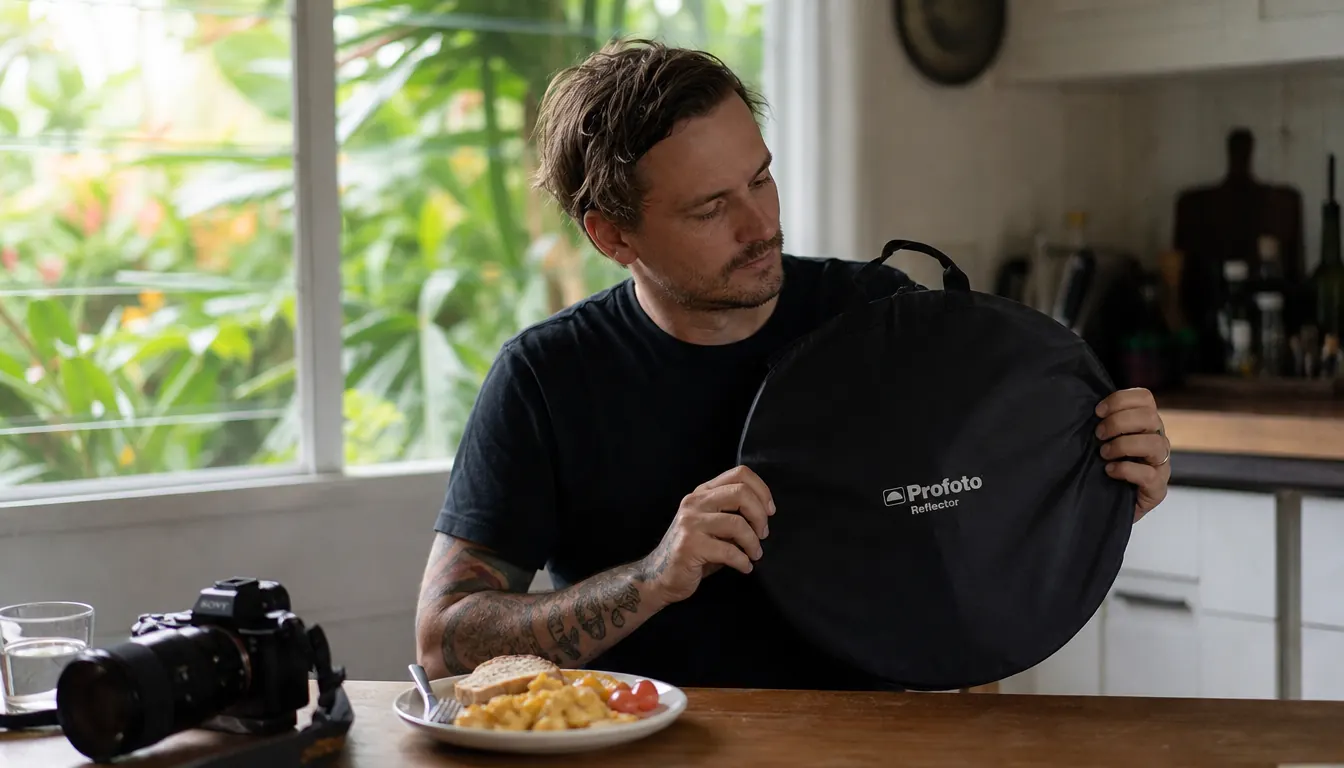
The Neewer 43 inch 5-in-1 reflector and a small portable LED panel solve the same problem from opposite directions. One bounces the light already in the room. The other makes its own. I bought the Neewer in April 2025 after nineteen months of propping a sheet of white foam board against a cereal box, and I have used it at my kitchen table in Hilo ever since. I have not bought an LED panel. I borrowed a friend's at camera club and watched her set it up for a fruit still life, which is enough to know where it beats my disc and where it does not.
Short answer: if you shoot food, cats, or portraits near a window, the Neewer is the better first buy. It is passive, broad, and forgiving. If you shoot at night, in a dark corner, or need the same light every single time, a small LED panel is the better tool. Most hobby photographers I know end up wanting both eventually, but not on the same day.
| Neewer 43 Inch Reflector | Small Portable LED Panel | |
|---|---|---|
| Light quality | Soft, broad fill that wraps around a plate or a face | Tighter beam that can look harsh on shiny surfaces |
| Reach | Fills a tabletop or a face and shoulders from a few feet away | Falls off fast, best for small subjects |
| Control | Five surfaces change the bounce, but the room decides the output | Brightness and color temperature can be dialed in |
| Power | None. It uses the light already in the room. | Battery or outlet, plus charging discipline |
| Placement | Needs a chair, clamp, stand, or patient helper | Small enough to set on a counter or shelf |
| Storage | Folds to about 16.2 by 15.4 by 1.6 inches and weighs 1.5 pounds | Smaller footprint, but more parts to keep track of |
| Night use | Weak without a strong room light | Works in a dark room |
| Outdoor use | No power needed, but it is not water resistant | Needs power and can be hard to see in bright sun |
| Durability | Steel frame, no electronics, 180-day warranty | Electronics and a battery to protect |
| Best for | Food, cats, portraits by a window | Night shooting, tight spaces, repeatable light |
How I Compared Them
I did not buy the panel. I want to be clear about that. A friend from camera club brought hers to a Saturday meeting at Liliuokalani Gardens, and I watched her light a plate of mochi and a bowl of fruit while I held my reflector on the other side of the table. I also read the listings and reviews for a few small panels, because that is what I do when I am curious and not ready to spend. My Neewer has been in and out of its bag for about nineteen months, mostly at my kitchen table and a few times on the lanai. I shot the same bowl of citrus at 9 a.m. with the Neewer on a chair and again with my friend's panel on the counter. I was not trying to prove one was better. I was trying to see which one I would actually leave set up.
I set that test up on a Saturday morning in early November, the kind of day when Hilo trades sun for rain every twenty minutes. My table faces a window on the north side of the kitchen, which gives me steady, cool light from about 8:30 until 10. I put a white bowl of farmers market citrus on a plain board at the table's edge: one lime, two tangerines, and a pomelo that was almost too big for the bowl. With the Neewer I propped the disc on a dining chair to the left of the bowl and angled it toward the window at roughly 45 degrees. My first frame was flat. The disc was too far forward and it was bouncing light straight back into the lens off the white plate. I slid it back about six inches and dropped it two inches lower, and the shadow side of the pomelo finally had shape instead of glare. That is the adjustment the disc asks for, and once you know what you are looking for it takes about ninety seconds.
Fair warning: this is not a lab test. I did not measure lux or color temperature. I looked at shadows, catchlights, and how much fiddling each tool needed before the food looked like food. That is the standard most hobby photographers I know actually use.
Where the Neewer 43 Inch Reflector Wins
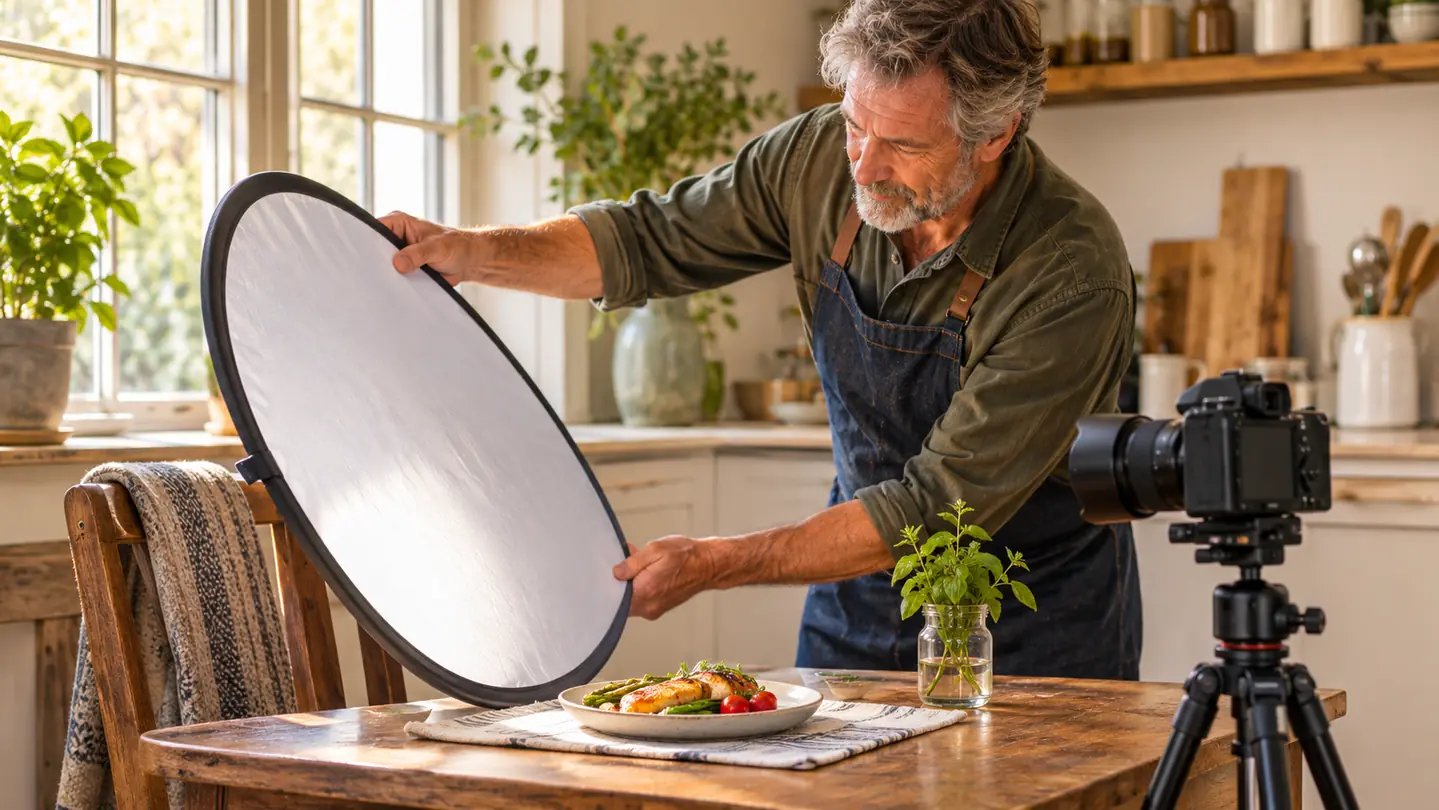
The Neewer wins on softness and coverage. A 43 inch disc placed a few feet from a plate is a large light source, even when it is only bouncing window light. Large sources make soft shadows. That is the whole trick. I set the disc on a chair beside the table, angled the reflective surface at the window, and the shadow under a bowl of saimin went from a black hole to a soft gray. No panel I have used at that size does the same thing without a diffuser and a stand and a little more room.
What surprised me is how much it helps with bounce off the plate itself. A white plate throws light back up under whatever is sitting on it, and that underlight is usually sharper than I want. With the disc angled in, that bounce gets softened instead of hard. I noticed it first on a bowl of lilikoi butter I shot at about 4 in the afternoon on the lanai, when the sun had gone behind the house and the ambient light had turned blue and flat. The disc pulled the warm light back in without a second light and without moving the bowl. That is a small thing until you have ruined a plate of food by chasing the light around the yard with it.
It also wins on simplicity. There is no battery to charge, no cable to trip over, and no menu to learn. The Neewer has five surfaces, and I mostly use two of them: the diffusion panel when the window light is too hard, and the reflective side when I need a little more light on the shadow side of a subject. I have also used it on the lanai for a portrait of Dale, my husband, who does not shoot and does not love being photographed. The disc lifted the shadow under his hat without making him look pasted into the scene. That is the kind of fix a reflector is good at. The disc also folds into a bag that slides behind my pantry door. That matters in a small kitchen. A panel would live on a shelf and need a charged battery when I want it.
Where the Small LED Panel Wins
The panel wins on control. The panel my friend brought had brightness and color temperature controls, and she could dial the light down until the highlights on a glaze stopped blowing out. The reflector cannot do that. If the window is too bright, I move the disc farther away or angle it off the subject. If the room is too dark, the disc has nothing to bounce. The panel just makes light, which is a real advantage at 7 p.m. in November when my kitchen window is done by 5:45.
It also wins on repeatability and footprint. The panel sat on the counter, took up less room than my disc, and gave the same light for every frame. If you are shooting the same bowl of fruit every week for a project, or you want to photograph a small object on a desk, that consistency matters. The Neewer is a bounce, so it changes every time the clouds change. That is fine for a hobby, but it is not the same as a dial.
One more thing the panel does that the disc simply cannot: it lets you shoot after dark without turning on the kitchen overhead. Mine is a single warm bulb that puts a yellow cast on everything and drops one hard shadow straight down the middle of a plate, which is exactly the shadow I spend all day trying to avoid. My friend's panel sat on the counter and gave a clean, even wash with no ceiling shadow at all. If your only shooting window is after dinner, that alone is the argument. A reflector needs light to bounce. At 8 p.m. in my kitchen there is none, and no amount of angling will manufacture it.
A 43 inch disc at three feet is a large, soft source. That is why the shadow under a bowl of saimin went from a black hole to a soft gray.
If your best light is a window, start with the Neewer disc
The 43 inch 5-in-1 folds into its own bag and leans on a chair, a clamp, or a patient friend. It is the simplest way I know to stop fighting shadows at the kitchen table.
Amazon Check Today's Price on Amazon →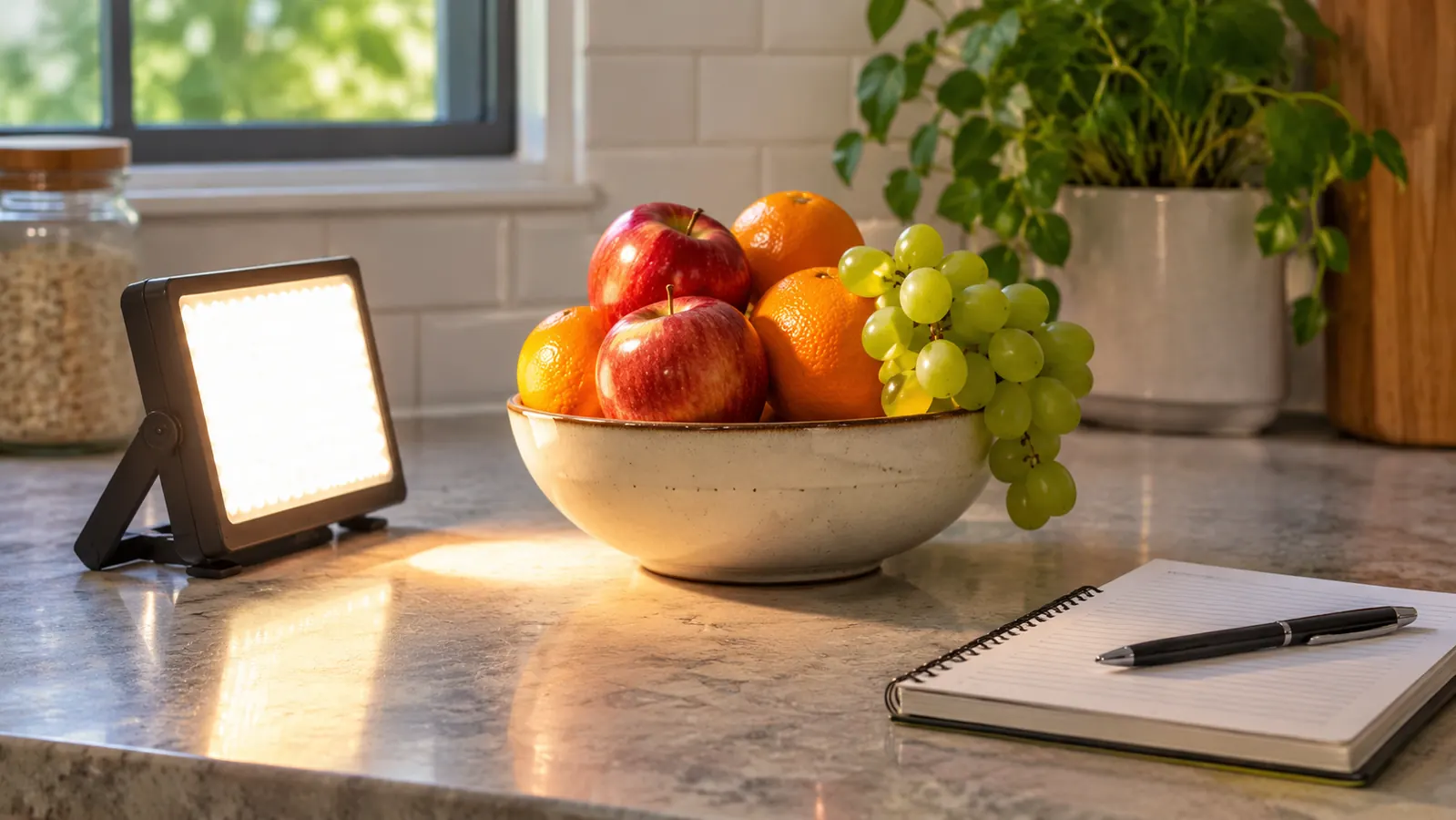
The Five Surfaces, and When I Use Each
The Neewer has five surfaces, and I do not use all of them equally. One surface softens the light when the window is too hard. One adds a clean fill on the shadow side. One warms the scene, which I use sparingly on food because it can make a white plate look off. One deepens contrast when I want more shape. One blocks stray light when I am trying to keep a reflection out of a shot. The bag keeps it organized, and the disc folds down for storage.
For food at my kitchen table, I mostly use the softening surface and the fill surface. For the cats, I use the fill surface and sometimes the warming surface, depending on the time of day. Mochi is a black cat, and she is hard to expose for. The disc helps me lift her shadow side without turning her into a gray cat. Pika, my gray tabby, is easier, but she walks into every shot, so the disc also gives me a way to light her when she refuses to stay where I put her. The blocking surface is the one I forget about and then wish I had remembered when a window reflection lands on a glossy plate.
The surface I use least is the warming one. It pushes everything toward yellow, and on food that can turn a white plate cream colored, which is not what I want when I am photographing something I cooked and want it to look the way it looked on the plate. I do pull it out in the late afternoon on the lanai, when the light coming through the trees already has a warm cast and the warmer bounce agrees with it instead of fighting it. The blocking surface is the opposite problem. I forget it exists until a reflection lands on a sauce or a glaze, and then it is the only thing in the bag that fixes the frame. Learning that took me two ruined shots of a dark glaze on a rainy Saturday, and now it is the first thing I reach for when something shiny is in the bowl.
What Neither One Fixes
Neither tool fixes a bad background. A reflector cannot remove a cluttered counter, and a panel cannot make a pile of mail look intentional. I move the clutter first. Neither tool fixes a window with direct sun and hard shadows at noon, either. The Neewer can soften some of that, but it cannot turn a harsh room into a studio. The panel can add light, but it cannot subtract the sun.
Neither tool is weather sealed. The Neewer listing says it is not water resistant, and I believe it. I keep mine out of the rain. The panel has electronics, so I would keep it out of the rain too. On the windward side of the Big Island, that matters. I shoot in the rain often, but I do not use either of these in it. I use a rain sleeve on the camera and I find cover. The reflector stays in its bag until the light is safe. A reflector also cannot fix a subject that will not sit still. Pika is a gray tabby with a lot of opinions. The disc helps, but a treat helps more.
Who Should Buy Which
Buy the Neewer 43 inch reflector first if you shoot near a window and want softer light without adding another device to charge. It is a good fit for food photos at the kitchen table, portraits on the lanai, and cats by the window. It is also a good fit if you are not sure what you need yet, because it teaches you how light moves. You will learn more from moving a disc two feet than from reading a manual. If you only shoot on sunny Saturday mornings, the Neewer is enough.
Buy a small LED panel instead if you often shoot at night, in a dark room, or in a corner where the window does not reach. It is also the better choice if you need the same light every time, or if you shoot small products on a desk and cannot spare the floor space for a 43 inch disc. If you shoot after work in a dim kitchen, the panel will earn its place. If you shoot both food and night portraits, save for both. I would still start with the Neewer, because it is the one I reach for first at home, but I would not pretend it replaces a panel after dark.
The disc that lives behind my pantry door
Nineteen months in, the Neewer 43 inch 5-in-1 is still the first lighting tool I pull out at home. It folds into its bag, leans on a chair, and turns a window into a softbox.
Amazon Check Today's Price on Amazon →