
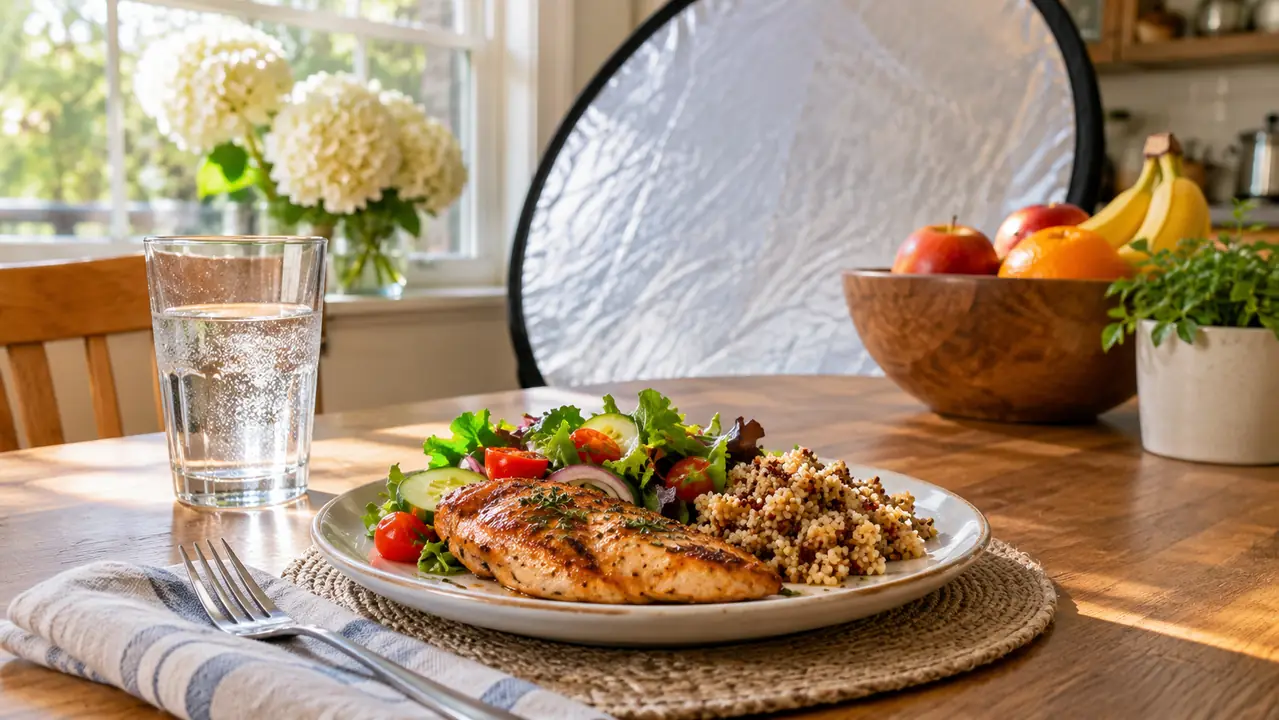
Here is a small, unglamorous thing that changed my food photos more than any lens I have bought: a folded disc that lives behind the pantry door. I shoot at my kitchen table most weeks. I cook, I plate it, I take four or five frames before the food goes cold. For years those frames came out gray. Not blurry, not badly framed, just flat. The window over the sink gives me soft light all afternoon, and soft light on a plate of food is like a blanket over a face. No shape. No edges.
For a while I propped a sheet of white foam board from the craft store against a cereal box on the far side of the table. It worked, sort of. Then the box would shift, the board would slide, and I would catch it halfway to the floor with one hand while holding a plate in the other. The board also creased down the middle, and that crease showed up as a bright line across the tablecloth.
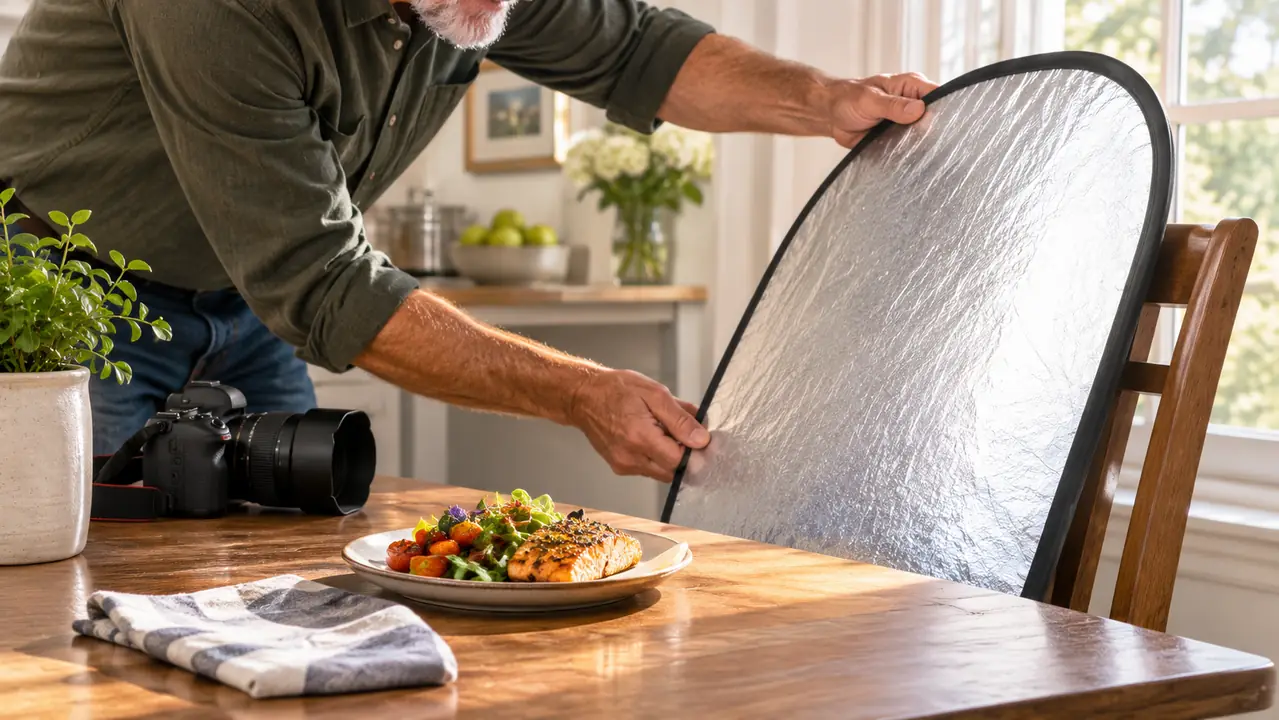
In April 2025 I bought the Neewer 43 inch 5 in 1 reflector, mostly because the foam board had stopped being funny. I have used it about nineteen months now, nearly every week, and it does the job the foam board was pretending to do.
It is 43 inches across, wider than my table is deep in one direction, and it folds down into a disc about 16 inches wide and an inch and a half thick. It weighs a pound and a half. The Neewer zip case is the reason this thing survived: it sits behind the pantry door, out of the way, and comes out when I need it.
Same plate, same window, same camera. The only thing that changed was a folded disc leaning against the fruit bowl.
The first plate I shot with it was a bowl of saimin, which is a bad test subject because everything in it is the same color. I set the white side of the disc on the far side of the bowl, tilted toward the window, and the broth went from a gray puddle to something with an actual surface. The noodles had edges. I sent the photo to a friend from the camera club and she asked what I had changed about my camera. Nothing. That is the whole point of a reflector: it does not add anything, it moves what is already there.
The white side did more for my food photos than a new lens did
43 inches across, five surfaces in one disc, folds into a case thin enough to live behind a door. Mine has been in weekly use for nineteen months of kitchen shoots and weekend trail mornings.
Amazon Check today's price on Amazon →The Neewer disc has five surfaces and I use three of them. The white side is the everyday one. It bounces window light back onto the shadow side of whatever I am shooting, so the dark parts get filled in without a second light. The silver side is stronger, closer to a direct bounce, and it is what I reach for when I want a highlight to sit up, on a piece of fish or a glass of something cold.
The translucent panel goes between the window and the subject when the afternoon sun comes in hard and leaves a shadow edge I cannot fix later. Gold I use almost never, mostly in December when the light outside is thin. Black is not a bounce at all. It blocks light, and I use it when I want the shadow side of a plate to stay dark on purpose. I have never once used all five in the same week.
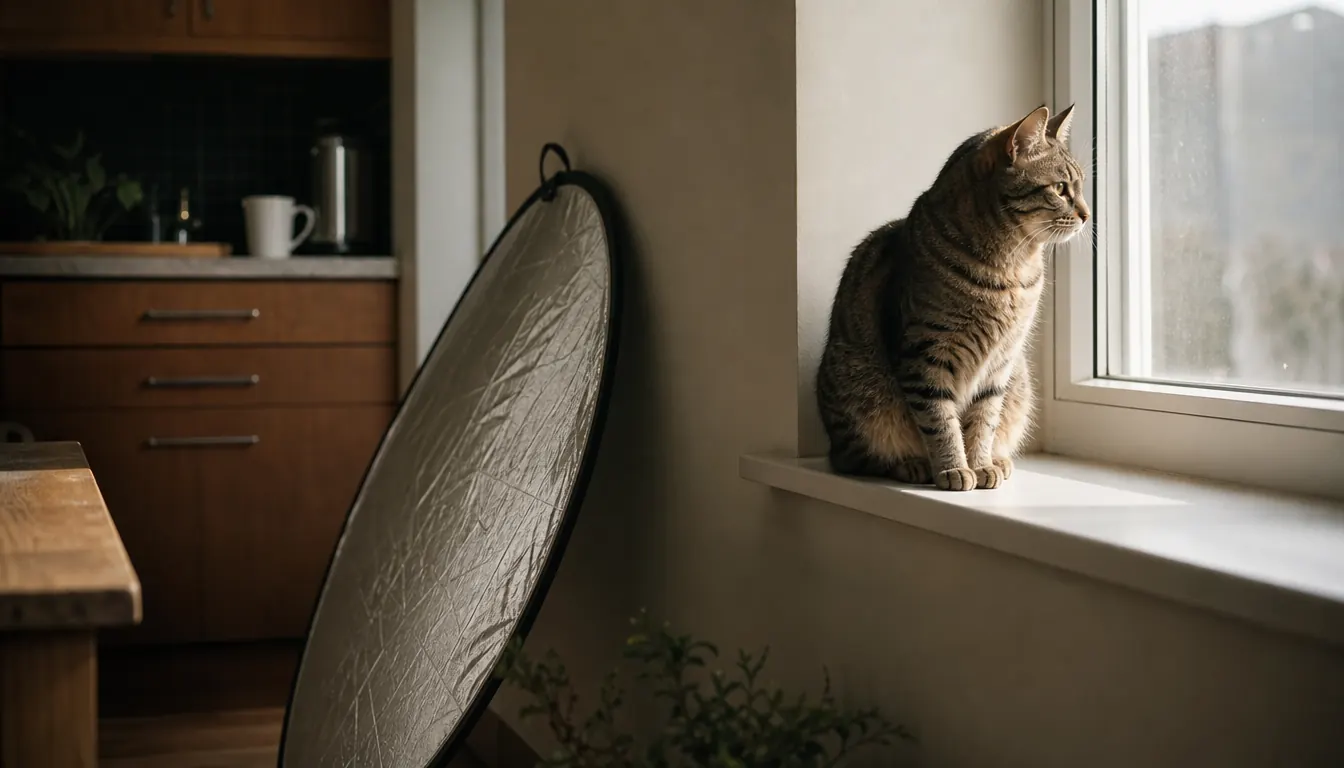
The cats are the other reason it stays out. Mochi is four, black, and photographs like a shadow with eyes. Bouncing the white side toward her when she sits by the window is the only thing I have found that puts any detail into her fur without blowing out the sill behind her. Pika is seven, gray, and cannot leave a scene alone. She walks into the frame the moment the disc comes out. I have forty photos of Pika in front of a reflector and not one good photo of the food.
I have taken it on two trail mornings and both times it stayed in the bag. At Onomea Bay the wind turned it into a sail, and it is not water resistant, so a wet Saturday is not the day. This is a kitchen and lanai tool for me. When I want light on a waterfall I use the tripod and a long exposure and let the light be what it is.
The honest limitation is size. 43 inches is a lot of disc for a kitchen, and I do not own a stand for it, so it leans. Against the fruit bowl, against a dining chair, against the edge of the counter. Indoors that is fine. On a breezy lanai it is not. There is a 180 day warranty card in a drawer that I have never needed.
What I'd Tell You If We Were Sitting at My Kitchen Table
Start with the white side. Put it opposite the window, not beside it, so the bounce comes across the subject instead of into your lens. Keep the edge of the disc out of the frame, and then look at the wall behind the food, because a bounce that fixes a plate can also light up the background and flatten the whole picture. Closer gives you a softer, stronger fill. Further away gives you a hint. Then take one frame with it and one without, on the same plate, two minutes apart. That pair of photos will teach you more than any tutorial.
If you shoot food, or cats, or anything small near a window, this is the simplest lighting change I know of. It is not a light. It does not plug in, it has no battery, and nothing on it can fail in the rain because it never goes out in the rain. It is a folded disc in a bag, and mine has earned its spot behind the pantry door every week for nineteen months.
Nineteen months later, it still comes out every week
Five surfaces, one zip case, about 16 inches folded. If your food photos look flat, try the white side before you buy anything with a battery in it.
Amazon See today's price on the Neewer reflector →