
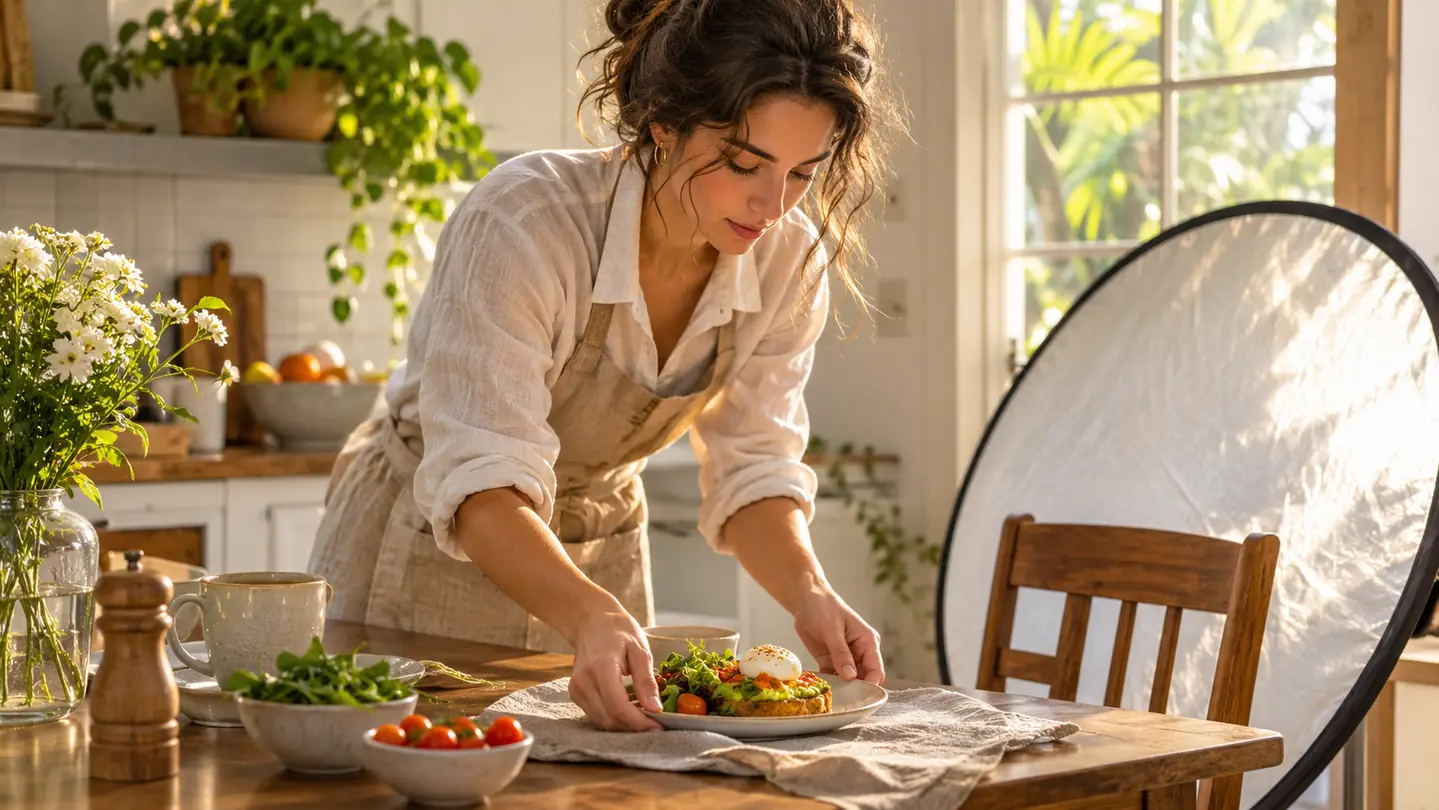
The first time I bounced window light onto a plate of food with something other than a sheet of craft store foam board, I felt a little foolish for waiting so long. I shoot at my kitchen table in Hilo, usually on Saturday mornings, and the light comes through one window at a low angle and does whatever it wants. I bought the Neewer 43 inch 5-in-1 reflector in April 2025. It has lived folded in its zip case behind the pantry door ever since, coming out two or three times a week.
Here is what it actually does for food photos, in the order I noticed it, with the annoying parts left in. None of it needs a studio, a stand, or a second person.
The gear I reach for before I touch a single camera setting
Five surfaces, one zip case, and a folded size that fits behind a door in a small kitchen. This is the Neewer 43 inch reflector I have used for about nineteen months.
Amazon Check Today's Price on Amazon →It turns one fixed window into a light you can aim
A window is a fixed light. It falls where it falls, and when the shadow side of your plate goes dark, you move the plate and hope. A reflector makes that light movable. I open the white side, prop it on the back of a dining chair at roughly 45 degrees, and the shadow side picks up a gentle lift. That is the whole trick. The 43 inch size matters here, because a small bounce gives you a small patch of light.
The white side fixes the gray flatness of a rainy morning
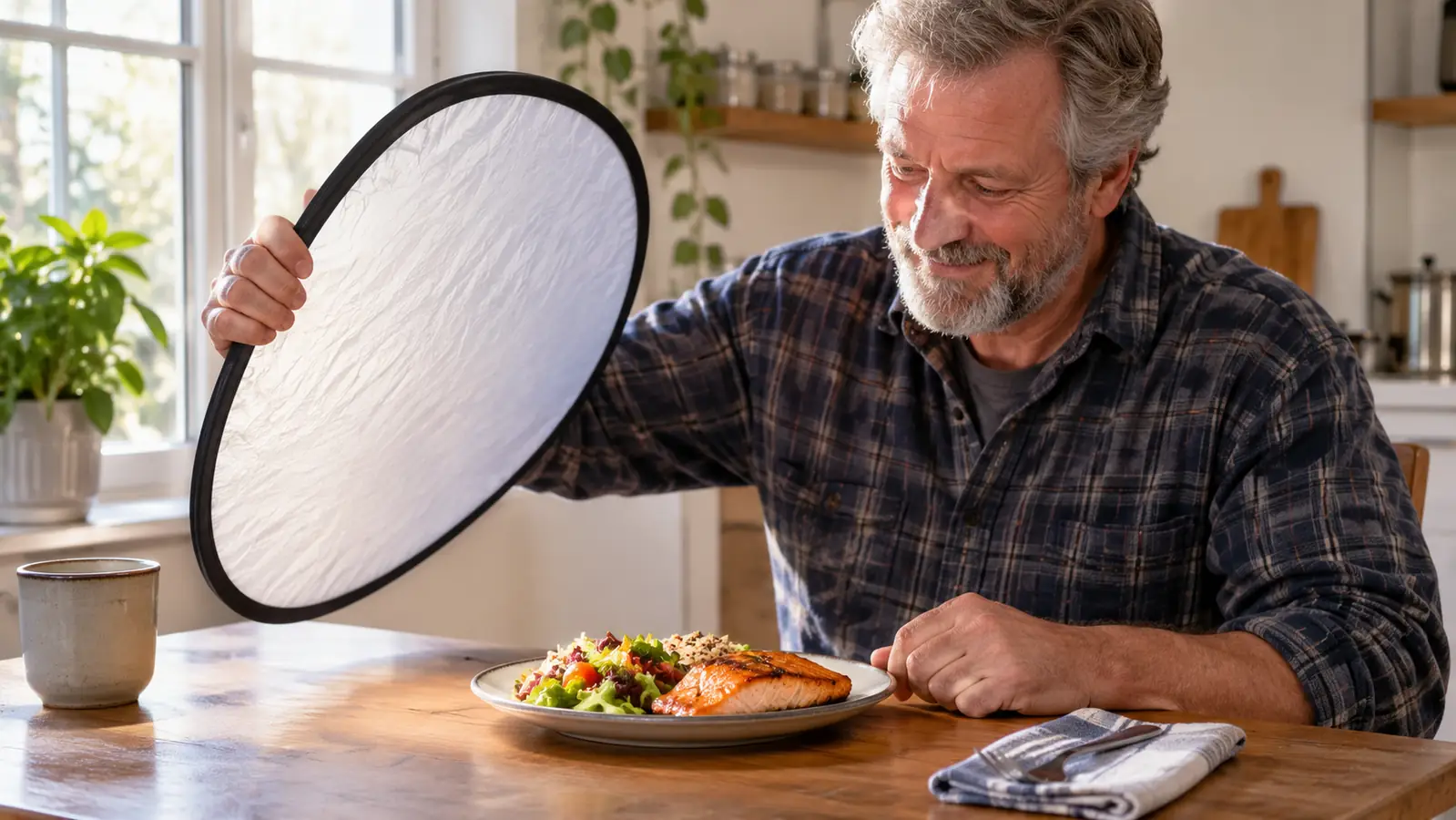
Overcast light is soft, and everyone says soft is good, but soft light with nothing to fill it reads gray and lifeless in a photo. I get a lot of those mornings on the windward side. White is the surface I use most for food. It does not add color, it does not add a hot highlight, it just lifts the shadow side enough that the food stops looking like it was photographed in a closet.
The silver side puts a crisp edge on a bowl or a plate rim
Silver is brighter and more specular than white. Used across the whole scene it can look harsh, and on food it can make a sauce look wet in a way that is not flattering. Used on one edge, it is lovely. I hold it low and to the side so a strip of light catches the lip of a bowl and separates it from the table. One edge, not the whole plate. That is the difference between a photo that looks lit and one that looks like a set.
The black side takes light away, and that is half the job
Nobody tells beginners that adding light is only half of lighting. My kitchen has a pale wall behind the table, and it throws light back into everything. The black surface goes on the near side and blocks that spill, so the shadow side of a subject goes properly dark. It is the least used surface in my set and the one that made the biggest difference when I finally tried it. It also works on the cats, which I will get to.
The gold side warms a plate without a white balance edit
Gold is the surface people overuse. I use it rarely and only at low strength, held far back. On a wooden board or a bowl of stew it adds a warmth that feels like late afternoon sun. On anything green it goes yellow and wrong, so I keep it away from salads and herbs. Knowing when not to use a surface is worth more than owning the surface.
The translucent panel softens a hard shaft of window sun
Mid morning here, the sun comes through my kitchen window as a hard shaft with a sharp edge, and it will burn a stripe across a plate. The translucent panel goes between the window and the food, and that shaft becomes an even wash. It is the same idea as a diffusion panel in a studio, dropped to kitchen scale. You do need to hold it or clamp it, and it takes a couple of tries to get the distance right.
It folds down to something you can store behind a door
The Neewer reflector opens to 43 inches, which is 110 centimeters, and folds down to roughly a third of that into a round zip case. It weighs about a pound and a half. In a small kitchen, that storage question is the whole ballgame. Mine lives behind the pantry door, and because it is out of the way, I actually use it. Gear that has to be unpacked from a closet does not get used at 8am on a Saturday.
You can hold it with one hand and shoot with the other
A 43 inch reflector at a pound and a half is light enough to hold in one hand while the other works the camera. I brace it against my hip, or tuck the edge under my arm, or lean it on a chair back. It is awkward for the first ten minutes. Then you find your two or three positions and it becomes automatic.
It works on cats by a window, not only on food
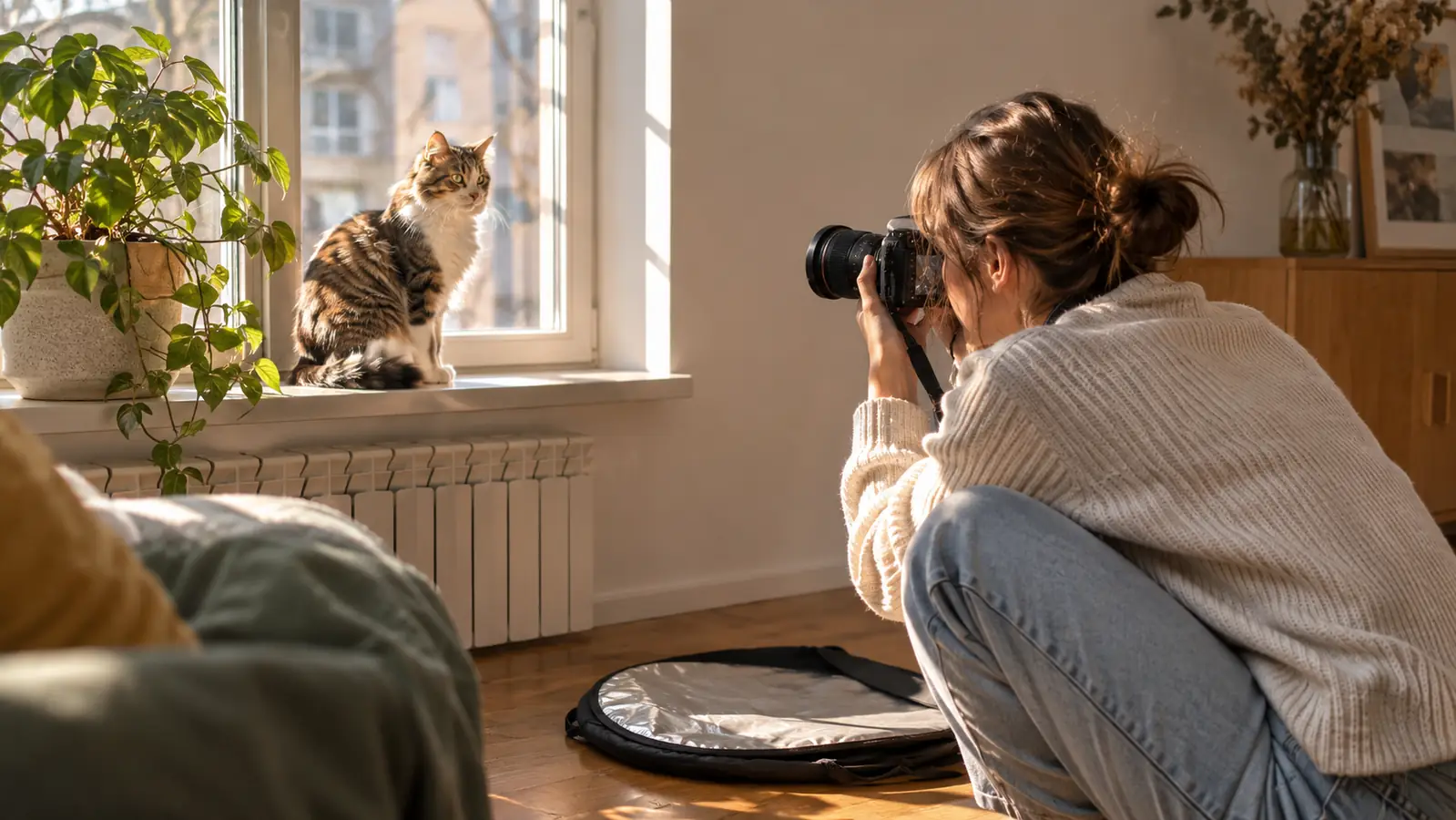
Mochi is black and shy, and she sits in a window in the afternoon where the light behind her is several stops brighter than she is. The white side, held at a distance, lifts her shadow side enough to see fur instead of a silhouette. Pika is gray and curious and walks into every shot, so she is easier. The same bounce that fills a plate fills a cat. That is why I stopped thinking of this as food gear.
It teaches you where light actually falls
This is the reason I would buy it again. Once you have moved a bounce around a plate for a few weeks, you start seeing the same shapes without it. You notice that the wall is throwing light, that the window has a hot side, that the shadow needs a fill. A piece of gear that trains your eye is worth more than one that only fixes a photo. This one does both.
What I'd Skip
Two honest limits. First, this thing is not water resistant, and I live in a place where that matters. I have carried it outside twice and both times I worried about the fabric, so it stays indoors now. If you want to shoot food on a rainy lanai, save it for a dry afternoon. Second, the black and gold surfaces get less use than the listing photos suggest. Gold especially can wreck a plate of greens. And you do not need a stand or a holder to start. A chair back, a stack of cookbooks, and one hand will carry you through the first year.
The white side is the one I use most, the black side is the one that surprised me, and the gold side is the one I would happily live without.
Nineteen months in, it still comes out of the case most weekends
Five surfaces, folds down to about a third of its open size, and weighs around a pound and a half. If your food photos are lit by one window and a lot of hope, this is the first thing I would add to the bag.
Amazon Check Today's Price on Amazon →