
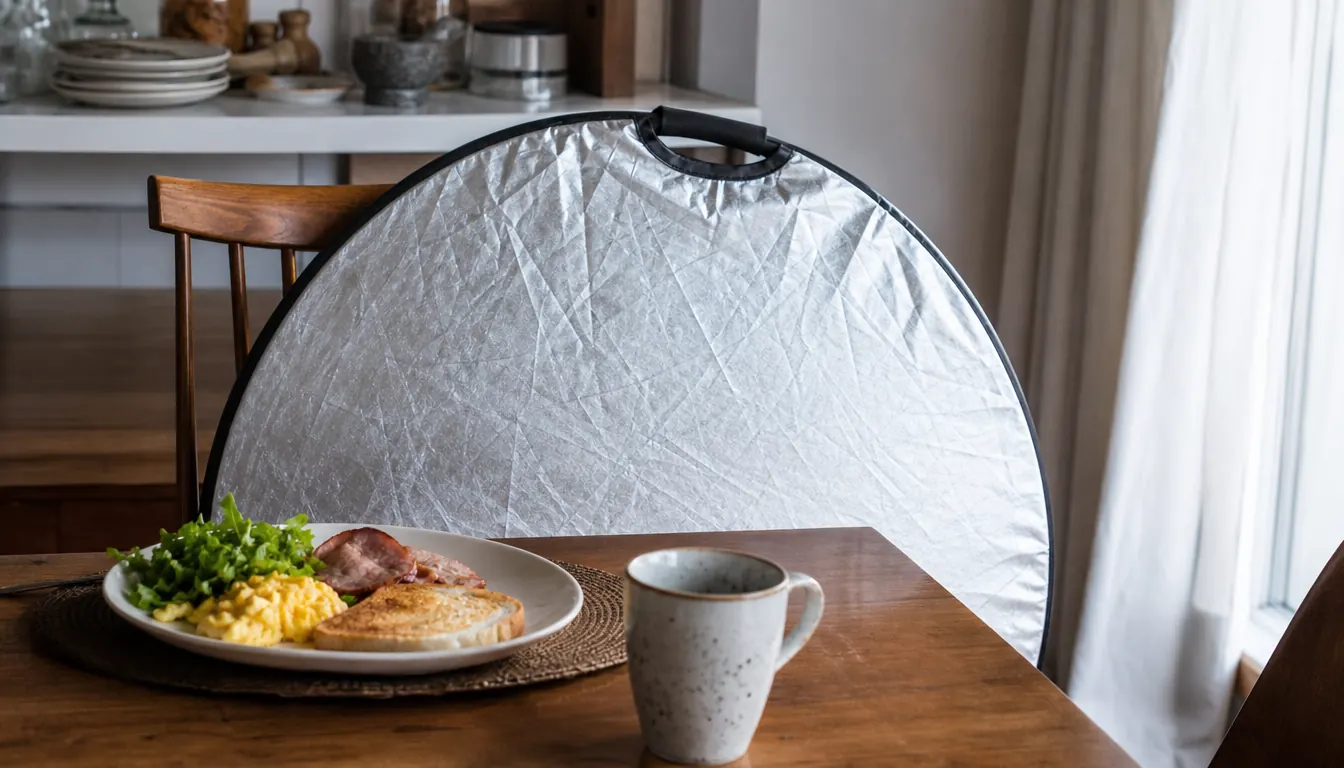
I bought the Neewer 43 inch 5-in-1 reflector in April 2025 because I was tired of taping a sheet of white foam board to the back of a kitchen chair. Nineteen months later, the foam board is in the garage and the Neewer lives behind the pantry door in its zip case. That sentence tells you most of what you need to know. But there are a few things about the size, the five surfaces, and the way it stores that I wish someone had spelled out before I ordered. This is the review I wanted to read.
I shoot rainforest trails, waterfalls, tide pools, food at the Hilo Farmers Market, my own cooking, and my two cats. I am not a studio photographer. I do not have an assistant holding a light. Most of my reflector use happens at the kitchen table, next to a window, with a plate of food getting cold while I fiddle. So this is not a spec sheet recital. It is what the reflector is like to own when your studio is a rental kitchen and your light stand is a chair.
The Quick Verdict
A genuinely useful five-surface reflector for window light, with one real catch: it needs space and something to lean on.
Amazon Check Today's Price →The five-surface reflector I still reach for after nineteen months
If your window light is almost right, the white and translucent surfaces are the place to start. The Neewer 43 inch 5-in-1 folds into its own zip case and needs no power, batteries, or app.
Amazon See the Neewer Reflector on Amazon →What Shows Up and What It Feels Like
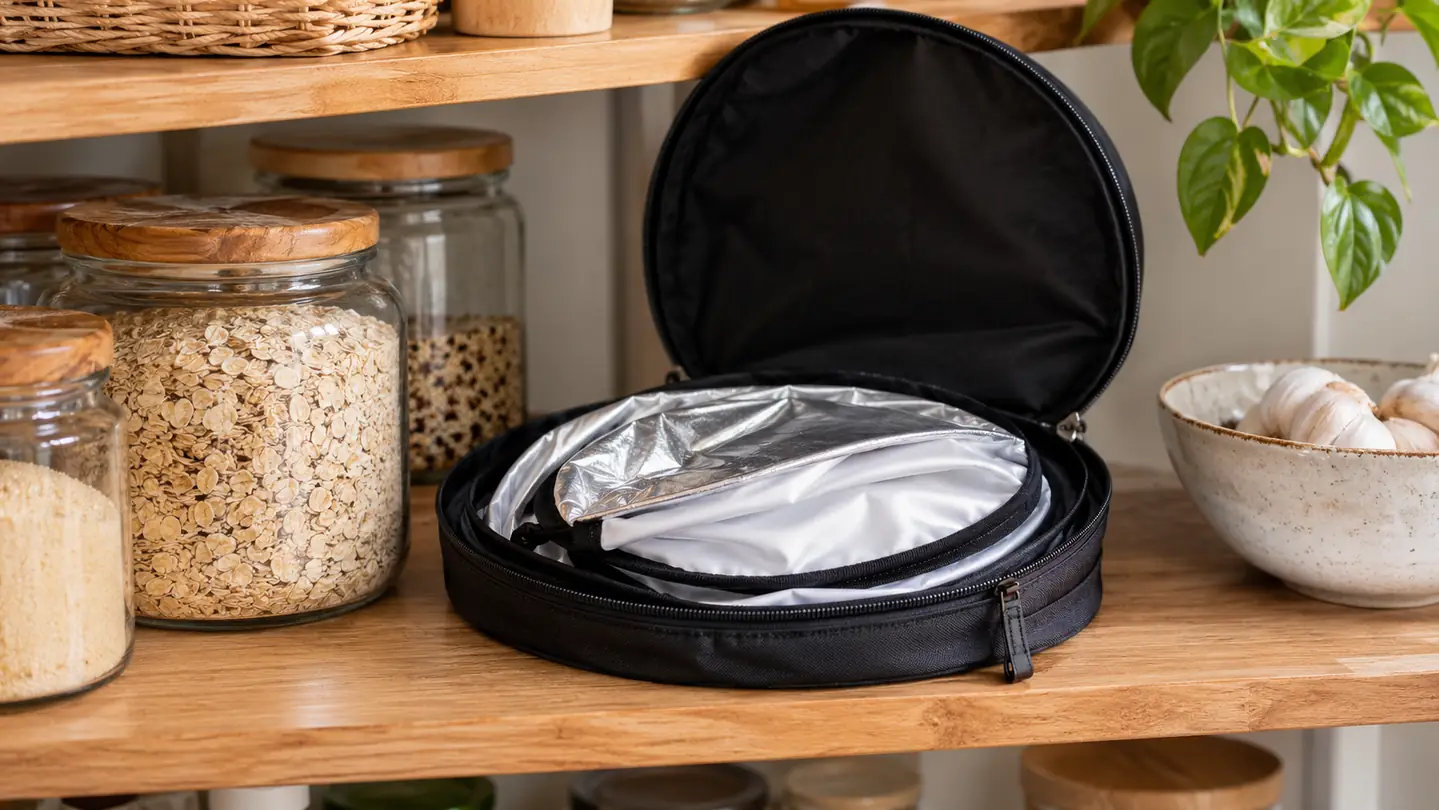
The package is simple: the 43 inch, or 110 centimeter, five-in-one disc and a zip bag. The disc gives you five surfaces to work with: translucent, silver, gold, white, and black. The listing says the bag keeps it organized for transport, and after nineteen months I can say the bag matters more than I expected. The reflector folds down to roughly 1.6 by 16.2 by 15.4 inches and weighs about 1.5 pounds. That is small enough to slide behind a door, not small enough to forget in a crowded camera bag.
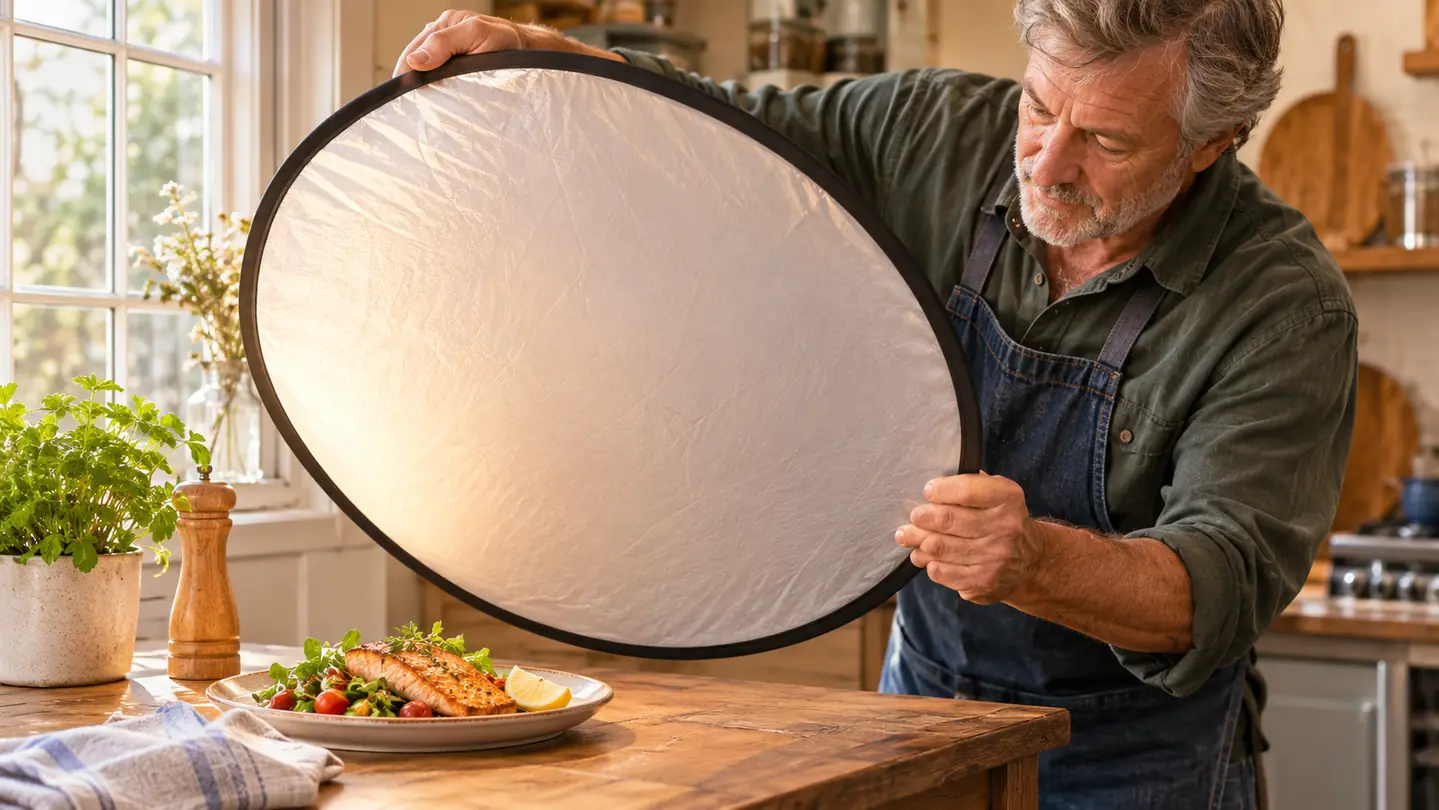
The first time I opened it, I did the thing everyone does. I held it up to the window, watched the light bounce onto the counter, and thought, this is going to be easy. It is not hard, but it is physical. You are holding a 43 inch disc with one hand, trying to aim a patch of light with the other, and hoping the cat does not walk through the beam. The Neewer does its job. It just does not do it by itself.
How I've Used It for Nineteen Months
My main use is food. I set a plate on the kitchen table, put the camera on a tripod, and lean the reflector against the back of a chair. The window is on the left, the reflector is on the right, and the white surface lifts the shadow side of the plate just enough that the food looks like food instead of a brown lump. The translucent surface is the one I use when the window light is harsh. It softens the edge of the light without killing the shape of the food.
The cats are the second use. Pika is a gray tabby who walks into every shot, and Mochi is a black cat who is hard to expose for. A white reflector bounced off the window helps more than any editing slider I have tried. It fills in Mochi's face without making her look gray. I have also used the black surface behind the cats when I want the background to fall away. I have not used the gold surface on the cats. Gold light on a black cat looks like a mistake in my kitchen.
Outdoors, I use it less. A 43 inch disc catches wind like a sail, and Hilo has plenty of wind. I have leaned it against a trail sign at Rainbow Falls and held it with my knee while shooting a tide pool at Onomea Bay, and both times I was more worried about the reflector than the photo. For a solo hiker, it is a fair-weather tool. For a food photo at home, it is the tool I reach for first.
I have also used it at Liliuokalani Gardens for a friend's portrait, and that is where the size made sense. The 43 inch disc gave a soft fill across her face from a few feet away. A smaller reflector would have made a hot spot. But I had Dale there to hold it, and I would not want to do that shoot alone.
After nineteen months, the white surface is the one that earns its keep. It fills Mochi's black fur without making her look gray.
The Five Surfaces, and When Each One Earns Its Keep
The translucent surface is a diffuser. I use it between the window and the food when the sun is coming in hard and the highlights on a tomato are blowing out. It softens the light and spreads it out. The catch is that it also eats some light, so on a gray Hilo morning you may need a slower shutter speed or a higher ISO. That is not a defect. That is what a diffuser does.
The white surface is my default. It is the one I use for food, for the cats, and for any close-up where I want a little fill without changing the color of the light. The silver surface is brighter and more specular. It gives a crisp highlight on a glass or a piece of fruit, but it can look harsh on skin. I use silver when I want a bit of snap on a plate of farmers market tomatoes, not when I am photographing a person.
The gold surface is the one I use least. It warms the light, which can be nice on a plate of curry or a loaf of bread, but it is easy to overdo. The black surface is not a reflector at all. It blocks light. I use it when I want the background to go dark behind a subject, or when I want to flag a window that is spilling light onto the wrong part of the table. Five surfaces sounds like a lot. In practice, I use two of them constantly, one occasionally, one rarely, and one for a specific job.
That is not a complaint. A five-in-one reflector is a compact way to carry options. If you only shoot food by a window, you could get by with white and translucent. If you shoot portraits or products, the silver and black earn their place. The gold is a taste thing. I would rather have it and not use it than need it and not have it. The one thing I would not do is buy a five-in-one and expect all five surfaces to change my work equally.
What I Liked
- Folds down to about 1.6 by 16.2 by 15.4 inches and 1.5 pounds
- Five surfaces cover fill, diffusion, warmth, and light blocking
- Included zip bag keeps it clean and out of the way
- 180 day warranty from Neewer
- No power or batteries to manage
Where It Falls Short
- 43 inch disc is awkward to hold alone
- Catches wind outdoors
- Not water resistant
- You need a chair, a wall, or a helper to lean it on
- Gold surface is easy to overdo
The Size Is the Whole Story
A 43 inch reflector is not a small accessory. When it is open, it is wider than my kitchen table is deep. That is the point. A small reflector gives you a small patch of fill. A 43 inch disc gives you a soft, broad source that can cover a plate, a cat, or a person's face. But it also means you need space. In my kitchen, I have to move the chair, clear the counter, and make sure Dale is not walking through the shot with a cup of coffee.
The folded size is the other half of the story. At 1.6 by 16.2 by 15.4 inches, it slides behind the pantry door in its bag. It does not fit in my camera sling. It would fit in a large tote or the back seat of the SUV, but I do not carry it on a hike unless I know I will use it. The weight is only 1.5 pounds, so the issue is not weight. It is bulk and setup.
The rim is the part that surprised me. It is springy and it wants to be round. Opening it is a two-hand job, and closing it is the same. If you have ever folded a car windshield sunshade, you know the motion. The first few times, I thought I was going to bend it. After nineteen months, it still folds and still springs back. I have not been gentle with it.
Storage, Care, and the Weather Problem
The included bag is a simple zip case, and it is the reason the reflector is still in good shape. Hilo humidity is hard on everything. I keep the reflector in the bag behind the pantry door, not in the garage and not in the car. The listing says it is not water resistant, and I believe it. I would not set it up in the rain. If I am shooting at Rainbow Falls and the mist is blowing, the reflector stays in the bag.
Cleaning is easy. I wipe the surfaces with a dry microfiber cloth, the same one I use for lenses. I do not use spray cleaner on it. I do not fold it wet. If it gets damp from condensation, I open it and let it air dry in the living room before it goes back in the bag. That is more care than the listing asks for, but it is what I do with anything that lives in this climate.
The warranty is 180 days. That is not a long time, but it is something. I have not had to use it. The surfaces have not cracked, the rim has not bent, and the bag has not lost its zip. That is not a guarantee for your use, just my experience after nineteen months of kitchen work and a few outdoor trips.
The Honest Annoyances
The first annoyance is that the reflector does not stand up by itself. You need a chair, a wall, a friend, or a knee. That sounds obvious, but in the first week I kept setting it on the table and expecting it to stay. It did not. The second annoyance is that the 43 inch size is a commitment. If you shoot in a tight kitchen, you will spend more time moving furniture than shooting. The third is wind. Outdoors, the disc turns into a sail. I have had it tip over on the lanai and I have caught it before it went off the table.
None of these are reasons to avoid it. They are reasons to buy it with your eyes open. The Neewer is a simple tool. It does not have batteries, it does not need an app, and it does not care what camera you use. It is a surface that bounces or blocks light. The tradeoff is that you have to hold it or prop it, and you have to have room for it.
How It Compares to My Foam Board
My old setup was a sheet of white foam board from a craft store. It was lighter and it was always ready, but it was also a flat rectangle that caught every breeze and showed every fingerprint. The Neewer gives me five surfaces in one bag and folds to a fraction of the footprint. The foam board still lives in the garage for a quick bounce, but the Neewer is what I take to the kitchen table.
The difference is control. Foam board gives me white fill and nothing else. The Neewer gives me white fill, silver snap, gold warmth, black flagging, and translucent diffusion. I do not use all five every week, but I use more than one every month. That is the case for a five-in-one over a homemade bounce.
Who This Is For
This is for the hobby photographer who shoots food, products, or pets near a window and wants more control than a sheet of foam board. It is for someone who has a chair, a wall, or a patient partner to lean it against. It is for the person who wants five options in one bag and does not mind a little setup. It is also a good fit for the photographer who is learning light and wants to see what fill, diffusion, and flagging actually do.
Who Should Skip It
Skip it if you shoot alone outdoors in wind, if you need something that packs into a small camera bag, or if you expect the reflector to stand on its own. Skip it if you shoot in rain or heavy mist and want one tool for every condition. This is not a waterproof product. It is not a light stand. It is a large, light, foldable surface, and it works best when you have a place to put it.
What I'd Tell a Friend
I would tell a friend to buy the 43 inch only if they have a room where they can leave it set up for a few minutes. If they shoot at the kitchen table, it is a good fit. If they shoot on the trail, a smaller reflector or a piece of white foam board in the bag might be easier. I would also tell them to start with the white and translucent surfaces and ignore the gold until they have a reason to use it. The Neewer is not a fix for bad light. It is a tool that makes window light go where you want it, and after nineteen months, that is still the reason it stays behind my pantry door.
If you have a chair and a window, you have a light setup
The Neewer 43 inch 5-in-1 is not a stand and it is not waterproof. It is a large, foldable surface that gives you five ways to shape window light, and that is exactly how I use it.
Amazon Check the Neewer 43 Inch 5-in-1 on Amazon →