
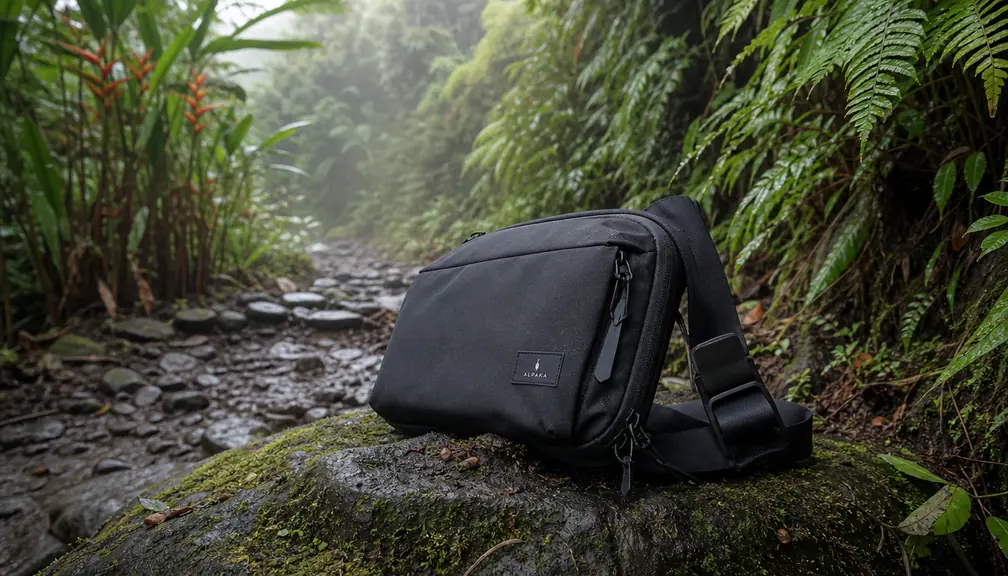
The first time I carried my camera up the trail toward Onomea Bay, I wrapped it in a dish towel and dropped it into my regular hiking daypack. Twenty minutes in, I stopped for a heliconia sitting in good light, and then spent the next minute taking the pack off, unclipping the lid, moving a water bottle out of the way, and unwrapping a towel. The light was gone before the camera was out.
That is the whole argument for a sling, and it is why the K&F Concept camera sling bag has been on my shoulder for weekend shoots since June 2025. It is not a camera backpack, and it is not a daypack with an insert dropped inside. It is a crossbody bag with a padded camera compartment, about 13 by 8.6 by 5.9 inches on the outside. On a wet windward-side trail, that turns out to be the right shape. Here are ten reasons it works for the way I actually shoot, and the limits I would want to know about before spending money on one.
The bag that stopped me unwrapping a camera in the rain
One body, two lenses, rain sleeves and a blower, in something that swings to your chest when the light changes. That is the entire job, and it does it.
Amazon Check Today's Price on Amazon →It swings around to the front without coming off your shoulder
The shoulder strap is adjustable and starts at 34.25 inches at its shortest setting, so the bag sits high and tight against my back when I am walking and still fits over a rain shell in a January shower. When something catches my eye, I rotate the bag around to my chest, unzip the main compartment, and the camera is already at hand. The part that matters: I never set it down on wet rock. On this island, most rock is wet rock.
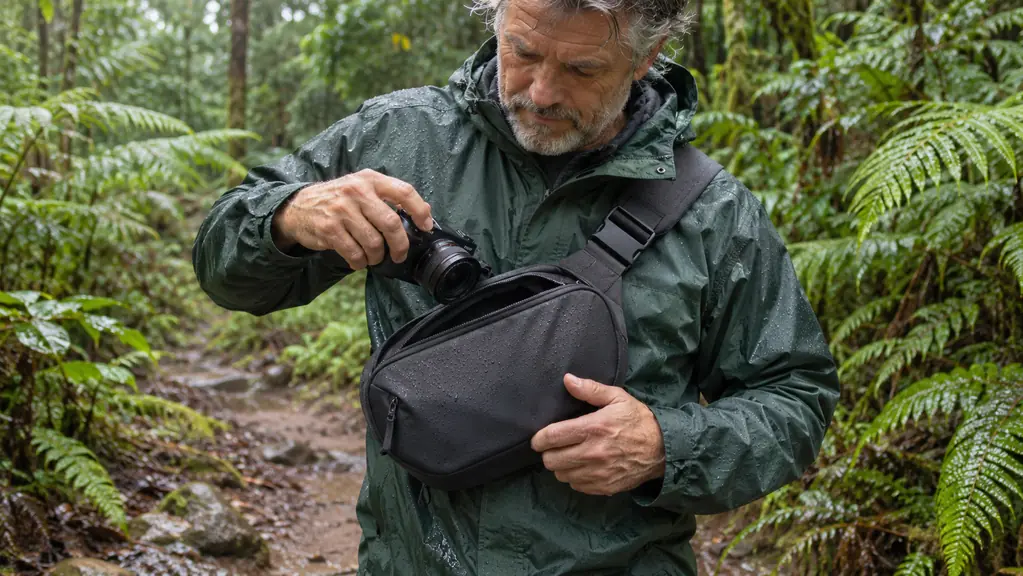
It holds one body and two lenses, which is my entire kit
The listing says it takes one camera and two lenses, and one flexfold divider comes with it. My everyday 24-105mm zoom rides on the body and the 70-300mm telephoto sits beside it, separated by the divider. That is everything I bring anywhere, so a bigger bag would just be empty space I have to haul up a hill. If you shoot with two bodies or three lenses, this is the exact point where you should look at something else.
The rain sleeves ride in the front pocket, not at the bottom of the pack
My OP/TECH Rainsleeve two-pack has lived folded in the front storage pocket since the day I bought the bag. In a daypack, sleeves migrate to the bottom under a jacket, and you find them after you are already soaked. Here they are in the pocket I open first. I have pulled one out mid-trail at Rainbow Falls more than once and had the camera covered in under a minute, which is faster than the rain takes to soak through a cotton shirt.
600 grams empty, so it never feels like a second pack
The bag weighs 600 grams with nothing in it, which is less than a full water bottle. Empty weight is the number I check first now, because a bag that is heavy before you put anything in it is a bag you leave in the car. This one goes on before I think about it. I notice it at the end of a long morning, not at the start, and that is the whole test.
Water resistant, which is not the same as waterproof
The shell is polyester with abrasion-resistant thread, and the listing rates it water resistant. I want to be exact about that, because I have seen people read it as waterproof and get angry later. Water resistant means it sheds a shower. It does not mean you can set it down in a puddle. We get rain most weeks on this side of the island, so I still carry a rain sleeve for the camera and I still tuck the K&F Concept bag under my jacket in a downpour. Seventeen months in, the coating has held and nothing inside has gotten soaked in normal weather.
Bottom straps for a small tripod, if you ever want them
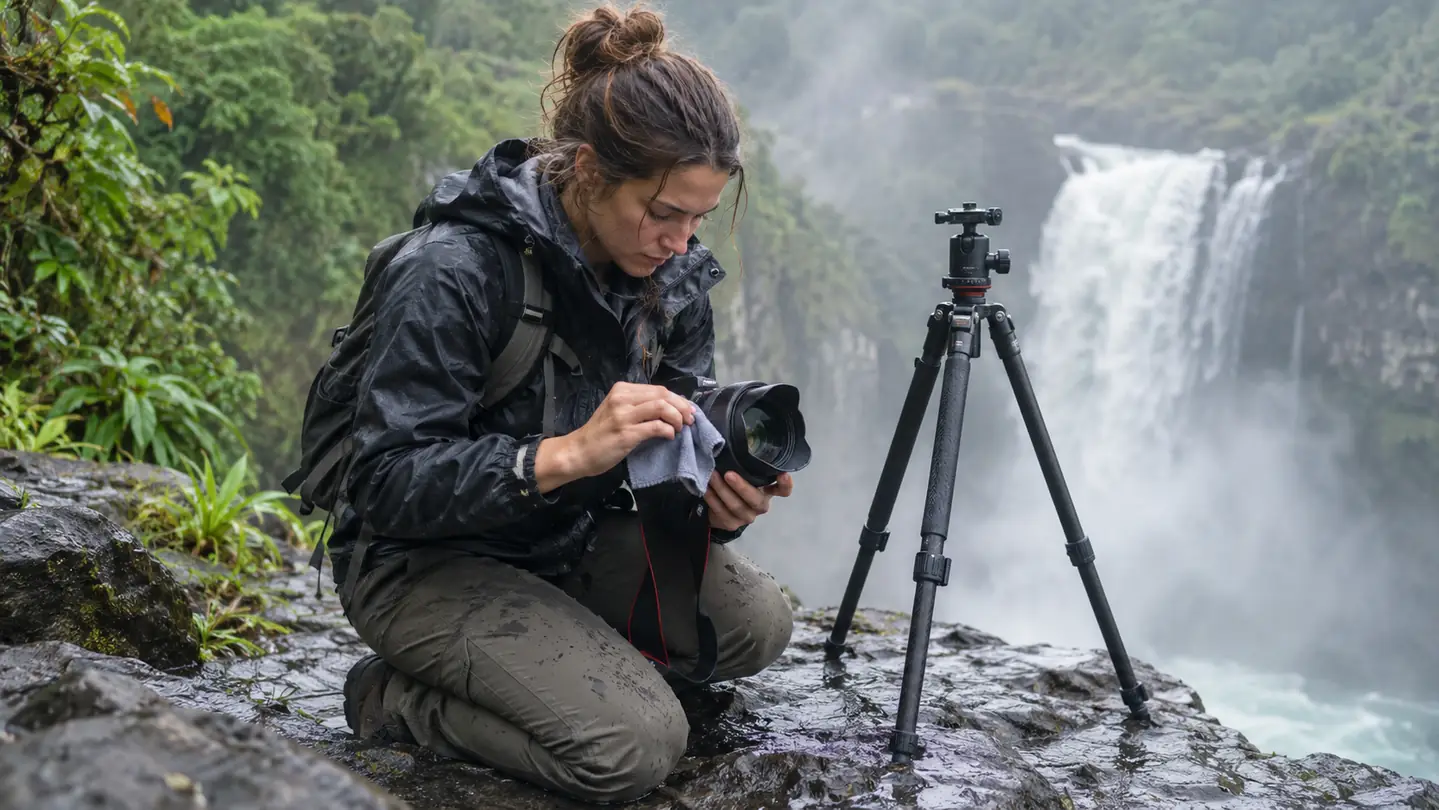
There are external carry straps on the bottom, sized for tripods with a maximum diameter of about 2.99 inches. I do not use them, because my Neewer N55C rides over my shoulder on its own strap when I want a long exposure at the coast. But the straps are there and they are not an afterthought, and if you carry a compact tripod this solves the one thing a sling usually cannot do at all.
A blower and a cloth live in it permanently
Humid air plus a lens that goes from a cool car into a hot trail equals fog, and fog plus a shirt hem equals smears. I learned that the slow way. Two pieces of my Altura cleaning kit live in the bag and never come out: the blower and one microfiber cloth. The independent storage pockets inside keep the cloth away from loose lens caps, so I am not hunting for it with wet hands. Keeping them there costs nothing and saves a shot every few weeks.
The soft shell sits flat against your back
The shell is soft rather than structured, so the bag lies against my back instead of standing off it. On the narrow boardwalks at Liliuokalani Gardens, that means I am not catching a stiff frame on every railing and branch. It also means the bag does not hold a shape of its own when it is half full. Pack it with intent and it carries well. Leave it mostly empty and it slumps a little.
Snacks, keys and a phone have their own pockets
There is a front storage pocket, a pocket on the back side that sits against your body, and the multi-functional pockets inside. Keys and a card go in the back pocket, out of sight while the bag is on my shoulder. A granola bar and a small water go in the front with my phone, which matters more than it sounds. Dale texts from home while I am at a trailhead, and I would rather answer with dry hands than unzip the camera compartment to reach it.
It reads as an everyday crossbody bag, not a camera bag
The pattern is solid and the shape is a plain shoulder bag, so walking through the Hilo Farmers Market on a Saturday I do not feel like I am announcing that I am carrying camera gear. That is not a theft-proofing claim, because nothing is. It is about not being the obvious bag in a crowd, and about carrying the same bag into a restaurant afterward without feeling like I am hauling equipment to lunch.
What I'd Skip
Two things I would not oversell. First, there is no waist belt and no frame, so if you are out for eight hours with a tripod, a second lens and lunch, a proper camera backpack will be kinder to your shoulders. Second, the warranty is six months, which is short for something with zippers that open every ten minutes. I have had no failures in seventeen months, but I am gentle with zippers and I do not stuff the bag past what it is built to hold.
And skip it if you shoot with two bodies. The K&F Concept bag takes one camera and two lenses and that is the ceiling. Buying a sling and then overloading it is how you end up with a bag that sags and a shoulder that aches by noon. One body, a zoom, a telephoto and rain gear is the load this bag is built around, and it is the test I would apply before you buy one.
Seventeen months of windward-side rain and nothing inside this bag has gotten soaked. It sheds a shower. It does not survive a puddle, and I do not ask it to.
If your camera still rides in a daypack wrapped in a towel, start here
One body, two lenses, rain sleeves, a blower and a cloth, in a bag that weighs 600 grams empty and swings to your chest when the light changes. That is the whole case for it.
Amazon Check Today's Price on Amazon →