
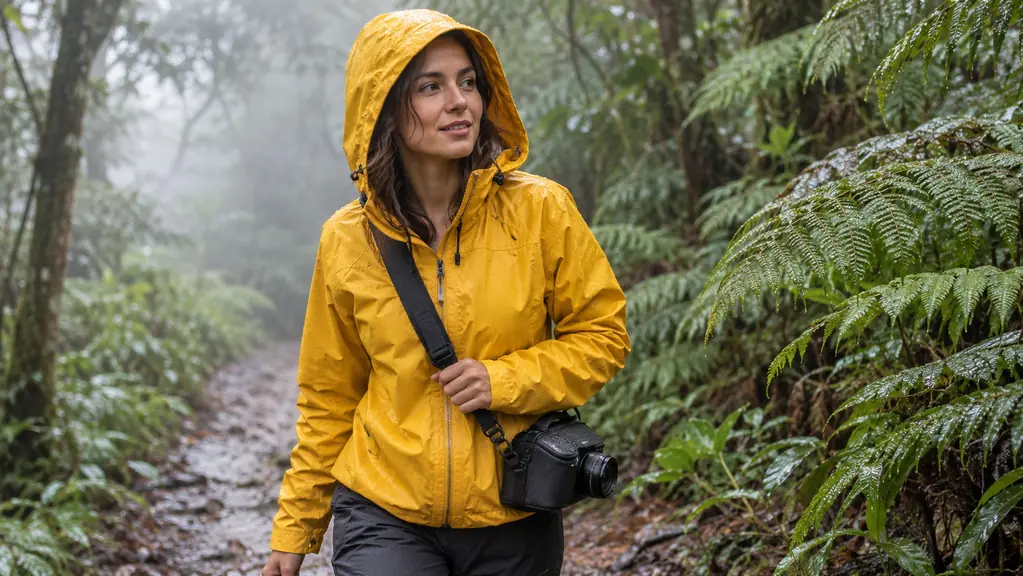
The first time I carried a camera up the Onomea Bay trail in the rain, I wrapped it in a dish towel and dropped it in my hiking daypack. By the time I got back to the car the towel was soaked, the body was soaked, and the front element had fogged from the inside out. I stood in the parking lot wiping it down with my shirt while the rain kept coming, thinking there had to be a less dumb way to do this.
There is. I bought a K&F Concept camera sling bag in June 2025 and I have carried it on wet trails for about seventeen months now. I will not tell you a sling bag is magic. What it does is put the camera at hip height, in front of me, where my hands already are, and it keeps the whole kit off the ground when I crouch. That is most of the battle on a rainy trail on the windward side. The rest is a routine, and the routine is what this guide is about.
The bag I reach for when the trail is running like a creek
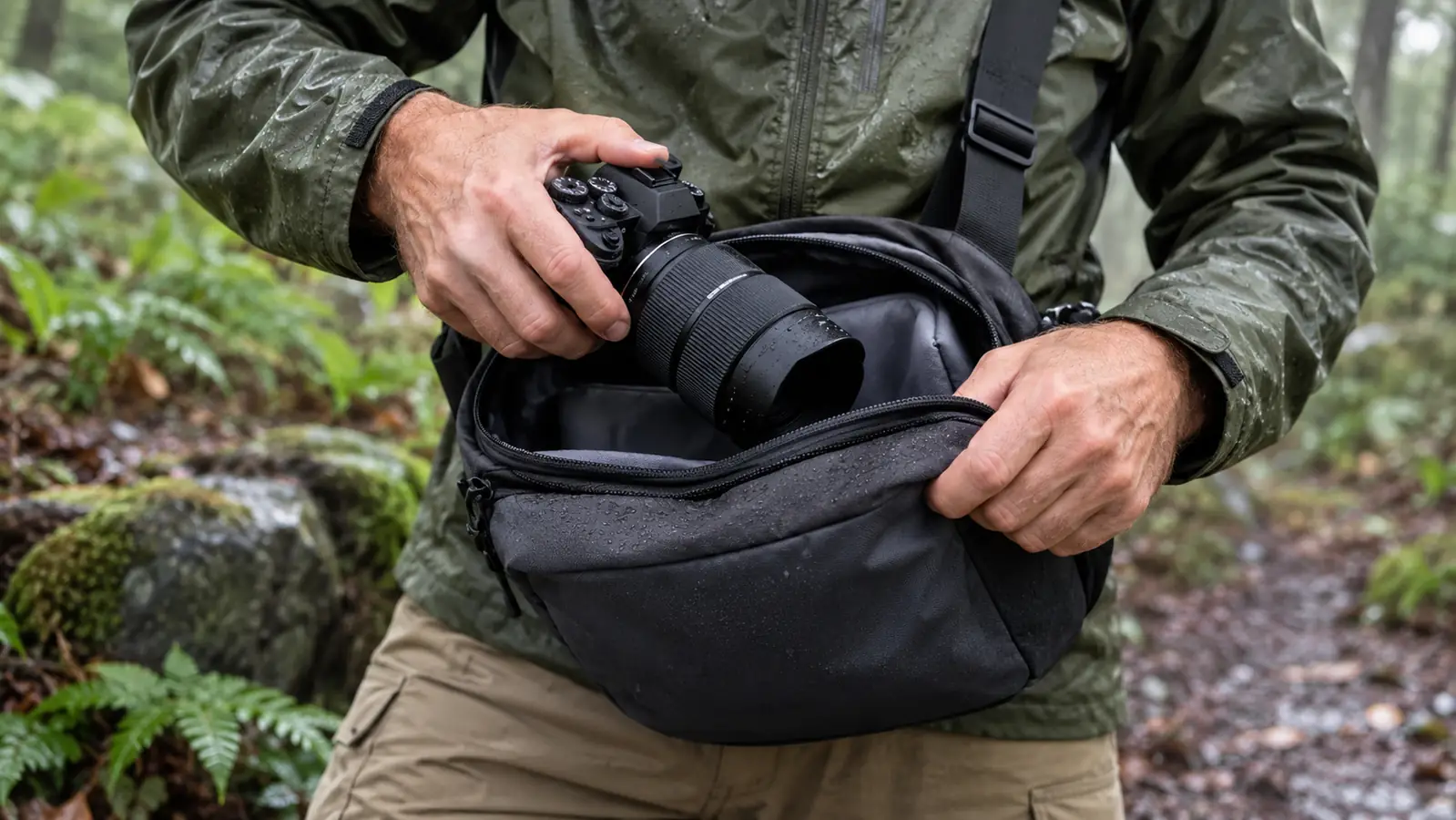
Ten liters, one adjustable crossbody strap, a flexfold divider I can move, and a shell the listing calls water resistant. My camera rides in it with the 24-105mm mounted, the 70-300mm beside it, and both rain sleeves in the front pocket.
Amazon Check Today's Price on Amazon →The Five Steps I Run Every Time
Step 1: Load It at the Kitchen Table, Not at the Trailhead
Packing in the driveway is how cameras get dropped. I load the sling bag on the kitchen counter the night before, with the lanai door open so I can hear how hard it is raining on the roof. The bag is small enough that loading it is a two minute job, and there is no excuse to rush it.
The layout has not changed once in seventeen months. The camera body with the 24-105mm mounted sits on one side of the flexfold divider, lens down, hood reversed. The 70-300mm stands up on the other side. The internal space is listed at 10.6 by 6.7 by 4.1 inches, the external at 13 by 8.6 by 5.9 inches, and that sounds like nothing until you realize the body and both lenses fit with a pocket left over for a granola bar.
Both OP/TECH Rainsleeve sleeves go in the front pocket, always, even when the forecast is dry. The blower and one microfiber cloth go in an inside pocket where I can reach them without opening the main compartment. Keys and a snack go in the back pocket. The K&F Concept bag weighs 600 grams empty, light enough that I forget I am wearing it until I need it.
Step 2: Wear It Crossbody and Swing It Forward Before You Kneel
The strap goes over my head and across my body, and the bag rides at my left hip. The shoulder strap is adjustable, listed from 34.25 inches, and I keep it short enough that the bag sits high and tight against my ribs. A bag that swings is a bag that bangs into rocks and railings, and I have done enough of that for one lifetime.
Here is the habit that matters. Before I kneel, crouch, or step down onto a wet rock, I swing the bag around to the front and clamp my forearm over it. It takes a second. The Onomea trail has tree roots the size of my arm, and the difference between a camera that survives a stumble and one that does not is usually whether the bag was in front of me or behind me when my foot slipped.
One Saturday last March I came down the switchbacks at Onomea with the bag riding behind my hip because I had let the strap out too far at the car. A root caught my toe, I put my hand out, and the bag swung around and hit the railing hard enough that I heard the 70-300mm shift in its slot. No damage that time, but my heart was going for a while. Now I check the strap length at the trailhead before the first step, and I keep the bag high enough that it does not pendulum while I walk.
The bottom external carry straps are the other thing I use more than I expected. They take a small tripod up to 2.99 inches in diameter. My Neewer N55C does not fit inside the bag, but on a short walk to Rainbow Falls I will sometimes lash it under the bag instead of carrying it in my hand the whole way down.
Step 3: Trust the Shell for Mist, Not for Rain
The K&F Concept sling bag is listed as water resistant, and that word is doing real work. Water resistant means mist, spray, a light drizzle, the wet leaves you brush past on a narrow trail. It does not mean the inside stays dry in a Hilo downpour. I learned that the polite way, by opening the bag after a ten minute walk and finding the top of the divider damp.
On a heavier day, the kind where the rain comes sideways off the ocean, I have opened the bag after twenty minutes and found the zipper tape beaded and the fabric dark with water. Nothing inside was wet, but it was close enough that I stopped treating the shell as the plan and started treating it as the backup. The sleeves are the plan.
So the rain sleeves come out before the rain does. If the sky has that flat gray color that means business, I pull one sleeve from the front pocket, fit it over the camera while the camera is still sitting in the bag, and settle it back down. The sleeve folds small enough that both live in that front pocket permanently. The first time I used one was a rainy Saturday at Rainbow Falls in January 2025, after a year of plastic grocery bags and rubber bands, and the difference was not small.
Zipper closed is the other half of this. A sling bag has one main zip and I keep it shut between frames, even when I am certain the next shot is two seconds away. It is the same discipline as keeping the lens cap on. Boring, and it saves you.
Water resistant is not waterproof. That single word is why both rain sleeves live in the front pocket and never come out of the bag.
Step 4: Change Lenses With the Bag Open in Your Lap
The windward side of this island runs between seventy and ninety percent humidity most of the year. That matters because the fastest way to fog a lens is to move it between a cool dry place and warm wet air. A camera that has been in an air conditioned car for forty minutes will fog the moment I step out at Akaka Falls. So I leave the camera in the bag with a window cracked, or I let the whole kit sit in the shade for ten minutes before I shoot anything.
When I do change lenses, the bag sits open in my lap, both lenses inside it, body pointing down. The flexfold divider gives me a wall to work behind. Nothing comes out into open air that does not have to. If it is actively raining, I do not change lenses at all. I shoot what the mounted lens sees and I go home. That is a dull answer, but a fogged sensor is a much worse afternoon.
There is a small habit I use with the telephoto. Before it goes back in the bag I loosen the zoom ring, set it to 70mm, and leave it there, so the barrel is short and there is less metal sticking up to collect condensation. It sounds fussy until the first time you pull out a lens with a fogged rear element and lose the shot you hiked for.
The small size helps here too. There is not enough room in ten liters for me to get sloppy. Two lenses and one body, and if I want a third thing along, something else stays in the car.
Step 5: Empty It and Let It Dry the Same Night
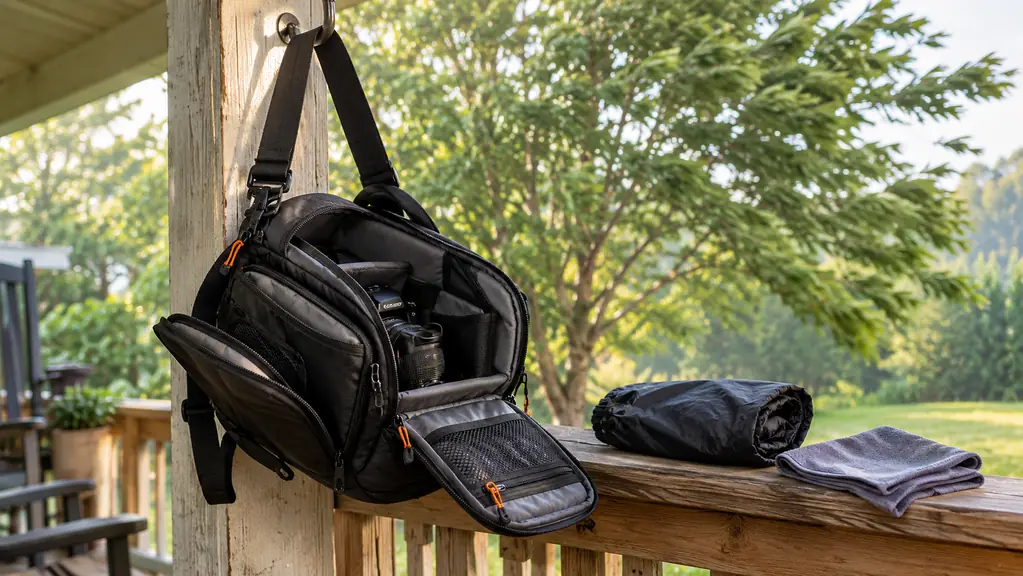
Wet gear that gets zipped up and shoved in a closet turns into a science project. When I get home I open every pocket, pull the divider out, remove the cloth and the sleeves and the snack wrapper I forgot about, and hang the bag on the covered part of the lanai where the trade wind can reach it. Not in direct sun. Coated fabric and strong sun are not friends.
I check the zippers while it hangs. Coated zips pick up grit from wet trail dust, and a zipper that sticks is a zipper you force, and a zipper you force is a zipper that opens when you are not paying attention. A pass with the dry end of the cloth is enough to keep both of them running.
The camera gets the same treatment. Blower first, then the microfiber cloth, and nothing else touches the front element. The rest of the cleaning kit lives in a desk drawer at home, because only the blower and one cloth belong in the bag. That was a change I made after I found a second cloth growing something unpleasant in a side pocket.
Then I reload it that same night, so the next Saturday morning starts with a bag that is already packed and a camera that is already dry. That one habit has bought back more shooting time than any piece of gear I own.
What Else Helps
Two cheap items do most of the support work. The first is the Altura Photo cleaning kit I bought back in August 2024, when I was still wiping lenses with my shirt hem and smearing whatever was on the shirt across the coating. Now the blower lifts the grit off before anything touches the glass, and that order matters more than the brand printed on the cloth.
The second is a rain shell with a chest pocket that actually closes. I keep a spare battery and a lens cap in mine. It sounds trivial until you are halfway down a trail with both hands full and nowhere dry to set anything down. A hiking pole helps too, used on the downhill side, mostly to stop me from putting a hand out to catch myself while the bag swings forward into a rock.
I also keep a small silica packet in the bottom of the front pocket and swap it every couple of months. It is cheap, and it is no substitute for hanging the bag open overnight, but across a week of back to back wet mornings it is the difference between a bag that smells like a gym locker and one that does not.
Where This Routine Breaks Down
A sling bag is not a pack. Ten liters holds a body, two lenses, sleeves, a cloth, a blower, keys and a snack, and that is the end of it. If I want water, a rain jacket and lunch, the sling goes over my shoulder and the daypack goes on my back, and I am right back to two bags, which is the exact problem I was trying to solve in the first place.
It also does not carry weight like a backpack. One strap means one shoulder, and by mile four on a long downhill I feel it. Anything past about three hours and I switch the bag to the other side for a stretch, or I admit to myself that this is a short trail bag and plan the day accordingly.
None of that makes the routine wrong. It just means the bag has a job, and the job is a wet two hour walk to a waterfall with one camera and two lenses. For that, seventeen months in, I have not found a better way to carry it.
If you shoot in the rain, pack for the rain
The sling bag, two rain sleeves in the front pocket, and a blower you can reach without opening the main compartment. That is the whole system, and it fits in ten liters.
Amazon Check Today's Price on Amazon →