
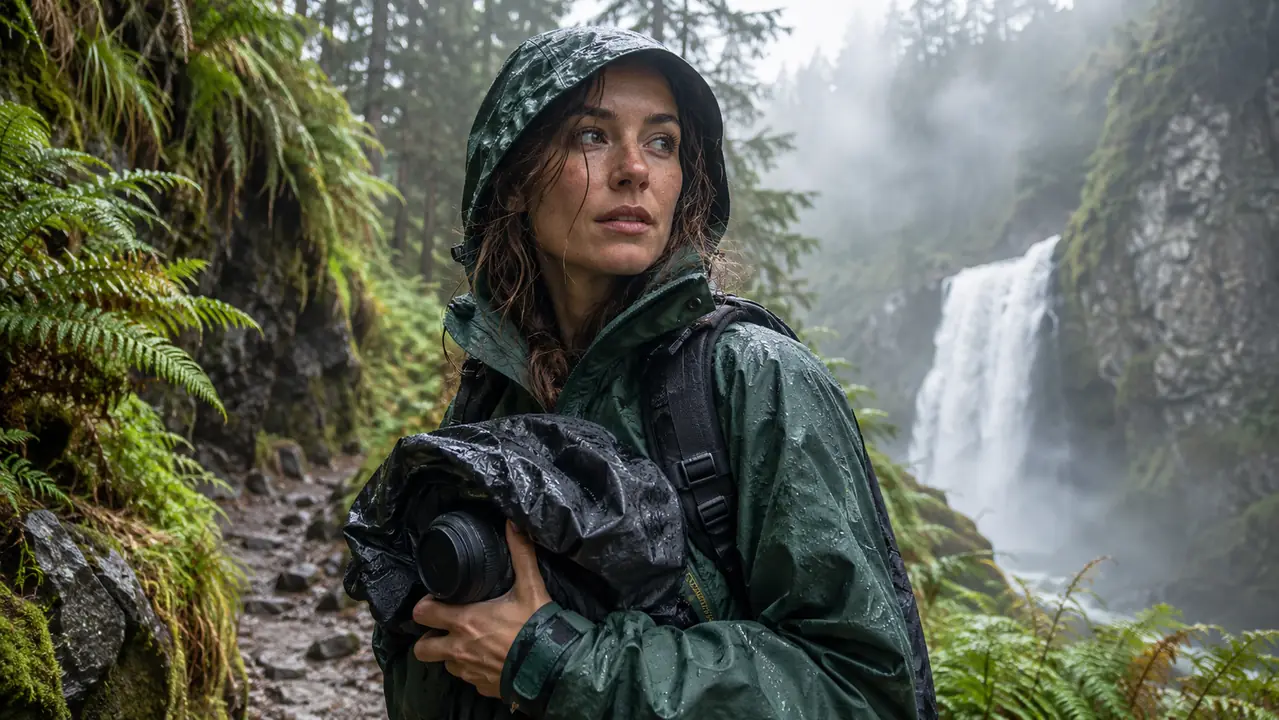
The forecast in Hilo is rain. Not a storm, just the windward drizzle that shows up most mornings and settles in for four or five hours, the kind that soaks a camera slowly while you are busy looking at a waterfall. For years my answer was a plastic grocery bag and a rubber band. It worked right up until I needed to change the shutter speed and could not see the dial through the folds.
In January 2025 I bought the OP/TECH USA Rainsleeve, a two-pack of clear camera sleeves, and it has lived in the front pocket of my sling bag ever since. That is about 22 months of use now, most of it on wet trails at Rainbow Falls and down at Onomea Bay. The other thing people ask me about is a fitted camera rain jacket: a tailored shell with sleeves and a sealed back that stays on the camera while you shoot. I have never owned one. I have handled a camera club friend's, and I have read more listings than I care to admit. So this is a fair look at both, including the places where my two sleeves lose.
The short answer: if you shoot in drizzle, mist and the occasional downpour, and you want something that lives in your bag and takes seconds to put on, the Rainsleeve is the practical pick. If you stand in real weather for an hour at a time, or you shoot with a long telephoto, a fitted jacket earns its place. Same problem, two different sizes of commitment.
| OP/TECH USA Rainsleeve | Fitted camera rain jacket | |
|---|---|---|
| What it is | A clear plastic sleeve, two to a pack, that slips over the camera and lens | A tailored shell with sleeves, a clear rear window and sealed seams |
| Coverage in steady rain | Keeps rain off the top and sides; the front element still relies on the lens hood | Covers the whole camera and your hands, with seams built not to seep |
| Long lenses | Small size is rated to 4.5 inches in diameter and 8 inches long, which suits a standard zoom | Made in sizes around long glass, with a proper opening at the hood |
| Seeing your settings | Clear material over the whole body, so the top dial and rear screen stay readable | Clear window at the back only; most controls end up under fabric |
| Getting it on | Over the lens, over the body, shooting again in about ten seconds | Arms in, viewfinder lined up, several points to cinch before you shoot |
| Packing it | Folds flat into a pocket at 27 grams, you forget it is there | Rolls into a bundle roughly the size of a water bottle |
| Wind | Loose plastic catches gusts and flaps against the lens hood | Fitted fabric stays where you put it when the wind picks up |
| Changing a lens | You take the cover off; there is no working through it | Some have side openings, but most still mean getting the camera out |
| When you get home | Shake it out, hang it, dry in an hour | Padded shells hold water in the seams and need a proper airing |
| How long it lasts | Thin plastic; expect a couple of seasons of regular use before it creases and clouds | Five or more seasons if you look after it |
| What is in the pack | Two sleeves, so one lives in the bag and one lives in the car | One jacket, sized to one lens setup |
| Warranty | Lifetime warranty against defects in materials and workmanship | Depends entirely on the brand |
How I Judged a Jacket I Do Not Own
The fitted jacket in this comparison is not mine, and I am not going to pretend otherwise. A friend at the camera club here in Hilo shoots shorebirds at Onomea Bay with one, and I have stood next to her in weather that made my sleeves look flimsy. I have also handled the display models at the shop in town, which is enough to feel how a jacket goes on and how much room it eats in a bag. Everything below about jackets comes from that, from listings, and from reviews I have read. Everything about the sleeves comes from carrying them for 22 months.
The morning that stuck with me was a Saturday in February, the one where the drizzle at Onomea Bay turned into something with actual intent. My friend had her jacket on in maybe forty seconds, hands inside, cuffs cinched, camera already pointed at a wandering tattler working the rocks. I got my sleeve over the body and the 24-105mm fine, but my hands were out in the weather the whole time, and by the time I had a frame I liked, my right hand was stiff enough that I fumbled the shutter button twice. She shot for an hour. I shot for about twenty minutes and then stood under the ironwood trees with the camera tucked inside my own jacket like a loaf of bread.
What I tried before the sleeves is worth saying, because it explains why I still bother with them. A grocery bag works for maybe ten minutes before the plastic clings to the lens hood and you cannot see the top plate at all. A dish towel draped over the camera does nothing, it just gets wet and then holds the wet against the body. Pulling my rain shell over both of us sounds clever until you are shooting blind under a hood, breathing on the rear screen, with the lens hood jammed into your sternum. I tried a zip-top bag one March and it fogged from the inside in under a minute, which is what happens when you seal warm humid air against cold plastic. The Rainsleeve was the first thing I tried that let me shoot close to normally with rain coming down.
What I compared, in order of how much it matters to me on a wet Saturday: how much of the camera stays dry in steady rain, how fast each one goes on when the sky turns, whether I can still read the top dial and the rear screen, how each behaves with my 70-300mm zoom on the front, and what happens when I get home with a wet cover and nowhere dry to put it. Those five questions decide whether a thing comes out of the bag at all.
Where the OP/TECH USA Rainsleeve Wins
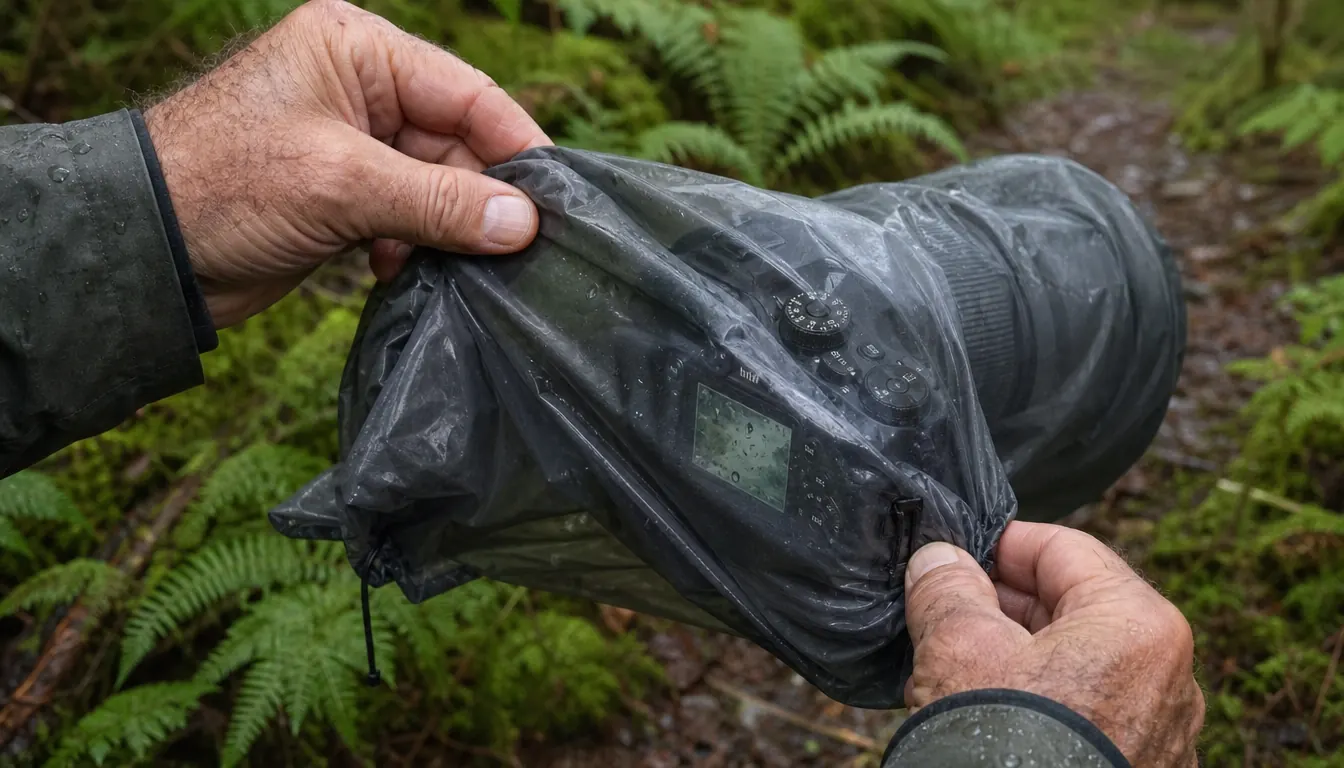
It wins on seeing what you are doing. The material is clear end to end, and the listing says it plainly: full visibility of the controls. That sounds like filler until you have tried to shoot through a grocery bag. With the sleeve on, I can read the top dial, see the rear screen, and put my eye to the viewfinder without lifting a flap or unzipping anything. There is no window to line up and no strap to thread. It goes over the lens, over the body, and I am shooting again. At Rainbow Falls in a drizzle, that ten seconds is the difference between getting the frame and watching the mist close in while I fiddle.
It also wins on the small, unglamorous jobs. I shoot at the Hilo Farmers Market most Saturday mornings, and the drizzle there is thin enough that a full jacket would be overkill but real enough that leaving the camera bare is a bad idea. The sleeve goes on, I shoot a tray of lilikoi bars and a stack of bananas and whatever the flower stall has that week, and it comes off again in the time it takes to walk to the next table. I do the same thing at my own kitchen table when the window light is good and the rain is coming down outside. Try that with a fitted shell and you will spend more time dressing the camera than composing the frame.
The clear material earns its keep in bright overcast too, which is most of our weather. On a grey morning the rear screen is the brightest thing in front of me, and being able to see it through the plastic without lifting a flap means I can check a histogram mid-shoot instead of guessing and hoping. I will be honest about wear: at 22 months the sleeve is starting to crease along the fold lines, and the material has gone slightly cloudy near the top where it rubs against the hot shoe area. Nothing has failed. It is just the first sign that these are consumables, not heirlooms, and it is why the two-pack matters more than it sounds like it should.
It also wins on the boring stuff. At 27 grams it folds flat into a pocket, and both sleeves live in the front pocket of my sling bag beside the blower and the cloth. It has never once been the reason I left something behind. When I get home I shake it out over the sink and hang it on the lanai railing; it is dry in an hour. A padded jacket needs real airing. Two to a pack means one can live in the back seat pocket of the car and one in the bag, so there is never a wet-Saturday search. And OP/TECH USA backs it with a lifetime warranty against defects in materials and workmanship, which is an odd promise to make about a piece of plastic and a good sign that they mean it.
Where a Fitted Rain Jacket Wins
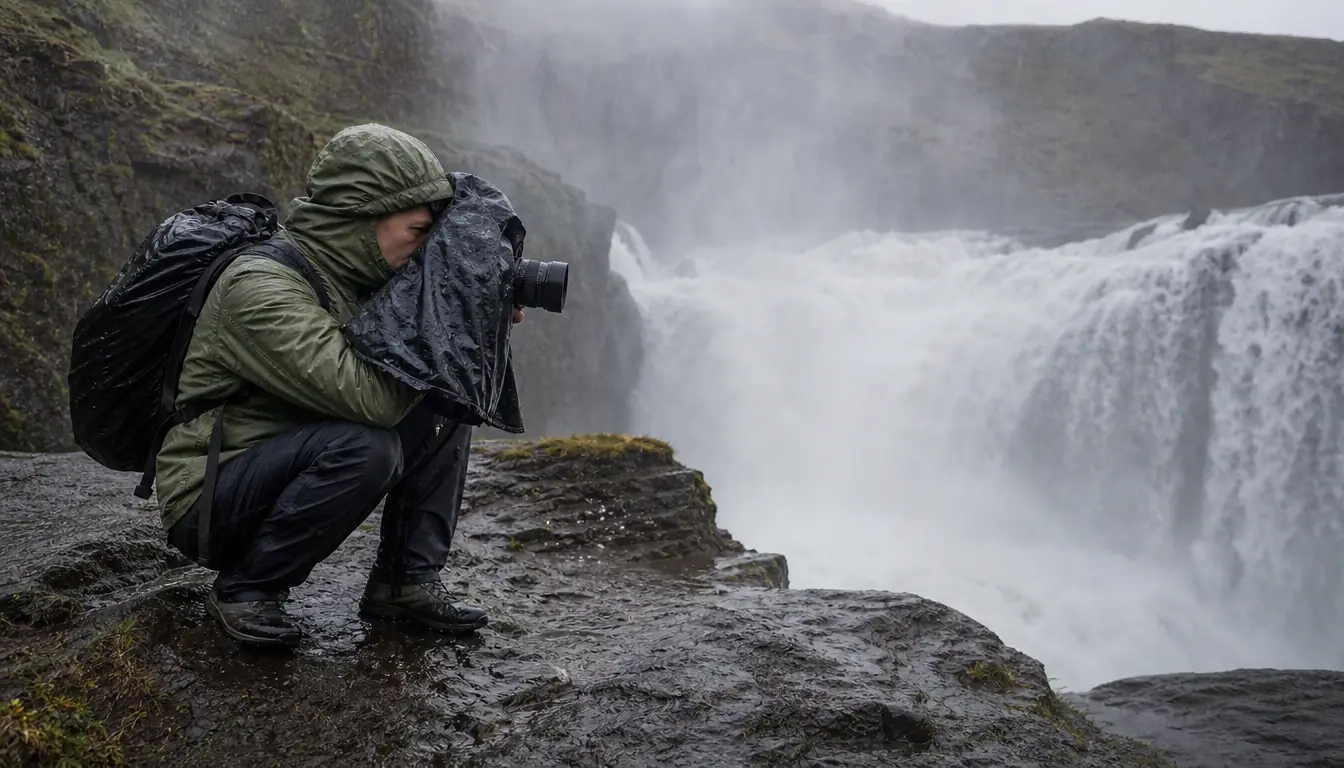
It wins on the weather that actually ruins cameras. Standing near the spray at Akaka Falls, the gap between dry and damp is seams and hands. A fitted jacket seals at the back, covers your forearms, and does not move. My sleeve has no answer to wind: loose plastic whips against the lens hood and spits water back at the front element, and my hands stay wet because they are outside the cover the whole time. If you are out for an hour in sideways mist, you finish the walk with cold fingers and a lens cloth that is already soaked. That is not a small thing.
The long lens problem is the one I feel most. My 70-300mm is what I use for the birds at the feeder and for anything on the far side of the water, and with the sleeve on, the body and most of the barrel are covered but the front section sits out in the weather with only the hood for company. The small size is rated to 4.5 inches in diameter and 8 inches long, and a 70-300mm racked out to reach is longer than that. In practice that means I hold the camera more carefully than I want to and I stop shooting sooner than I want to. Fitted jackets are cut around exactly this, with a real opening at the hood and room to get at a tripod collar without peeling the cover back.
The other thing a jacket does that no sleeve can is keep your hands in. At Akaka Falls in March I spent about forty minutes on the viewing platform in a mist so fine it did not look like rain at all, and by the end my fingers were stiff and the lens cloth in my pocket was a wet rag. I was wiping the front element every few frames, which is also how you eventually scratch one. A jacket with sleeves would not have fixed the cloth, but it would have kept my hands working, and working hands are what gets the shot when the light is changing under you.
And there is durability. Mine is intact at 22 months, but it is thin plastic, and thin plastic creases, clouds and eventually splits along a fold. A jacket you look after, dried properly and stored rolled rather than stuffed, will outlast a drawer full of sleeves. If you shoot in rain every week, the arithmetic eventually favors the more expensive thing.
One folded sleeve in the bag beats a soaked camera on the trail
The clear material keeps every dial readable, it packs down to nothing, and the second sleeve lives in the car so you are never caught without one. For drizzle, mist and the average wet Saturday, this does the whole job.
Amazon Check Today's Price on Amazon →Who Should Buy Which
Buy the Rainsleeve if your shooting looks like mine. You walk trails, you stop at waterfalls and tide pools, you photograph food on the kitchen table and the birds at the feeder, and the rain is an interruption rather than the point. You want something that disappears into a sling bag, goes on in seconds, and lets you keep shooting instead of packing up. You shoot with a standard zoom, you are not standing still in spray for an hour, and you would rather spend the money on a lens than on fabric. Two sleeves in a pack also means you can leave one at home or in the car, wherever you keep finding yourself without it.
Buy a fitted jacket if the weather is the assignment. You shoot seabirds on the coast, you stand in spray at the shoreline for an hour, you work in wind that turns drizzle sideways, or you shoot long glass that a sleeve cannot fully cover. It is also the better choice if you are out in rain often enough that putting a cover on and off twenty times a weekend becomes its own annoyance. The honest position is that these two are not really competing. One is a thing you keep in your bag in case. The other is a thing you plan around.
If you are genuinely torn, buy the two-pack first and use it for a few wet Saturdays. It is the smaller mistake, and it covers most of the year here. Then pay attention to what actually ends your shoots. If you are cutting them short because your hands are cold, or leaving the telephoto at home because the sleeve does not really cover it, that is your signal to start looking at a jacket. You will be buying it for a reason you found yourself, which is a much better way to spend the money than taking my word for it.
Twenty-two months, a lot of wet Saturdays, and the sleeve still folds into the same pocket it started in. What it has never done is keep my hands dry.
Start with the two-pack, and upgrade only if the rain gets serious
Most hobby shooters never need more than this: a clear cover that folds flat, keeps the controls visible, and costs you nothing in bag space. If you later find yourself standing in sideways mist for an hour, you will know exactly why.
Amazon See the Rainsleeve 2 Pack on Amazon →