
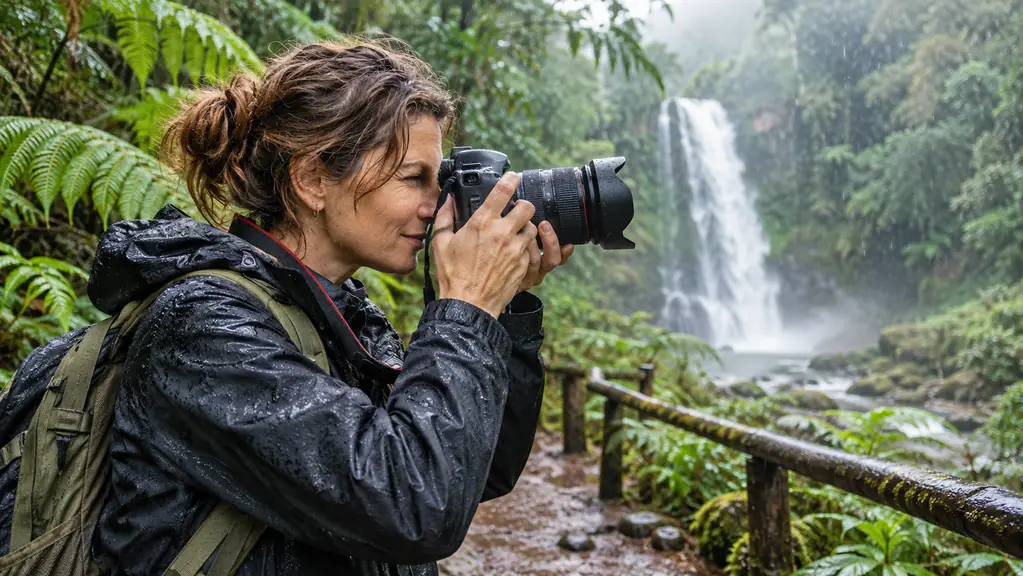
Rain on the windward side of the Big Island does not arrive on a schedule. It comes in sideways, it comes while the sun is still out, and it comes in the ten seconds between taking the camera out of the bag and raising it to your eye. For years my answer was a plastic grocery bag and a rubber band, which worked about as well as it sounds. In January 2025 I bought the OP/TECH USA Rainsleeve two-pack, and a folded sleeve has lived in the front pocket of my sling bag ever since.
I am not going to tell you a folded sleeve is a substitute for a weather-sealed body, because it is not. What I will tell you is that a sleeve you actually carry beats a fitted jacket you leave at home, and that the difference between a wet camera and a dry one is usually about thirty seconds of preparation. Here are ten reasons it earns the pocket space.
The sleeve that lives in my bag, not in a drawer
OP/TECH USA Rainsleeve, two per pack. The small size fits camera and lens setups up to 4.5 inches across and 8 inches long.
Amazon Check today's price on Amazon →Hilo rain gives you about fifteen seconds of warning
The first reason is local. On the trails above town the rain does not build, it arrives. I have stood at Rainbow Falls with a dry camera and walked back to the car with a wet one more times than I want to admit. The sleeve takes about that long to get on: camera in, sleeve settled over the body, and you keep shooting. Nothing about it is complicated, which is exactly the point when the sky opens and you have a decision to make in the moment.
It weighs 27.22 grams, so there is no reason to leave it behind
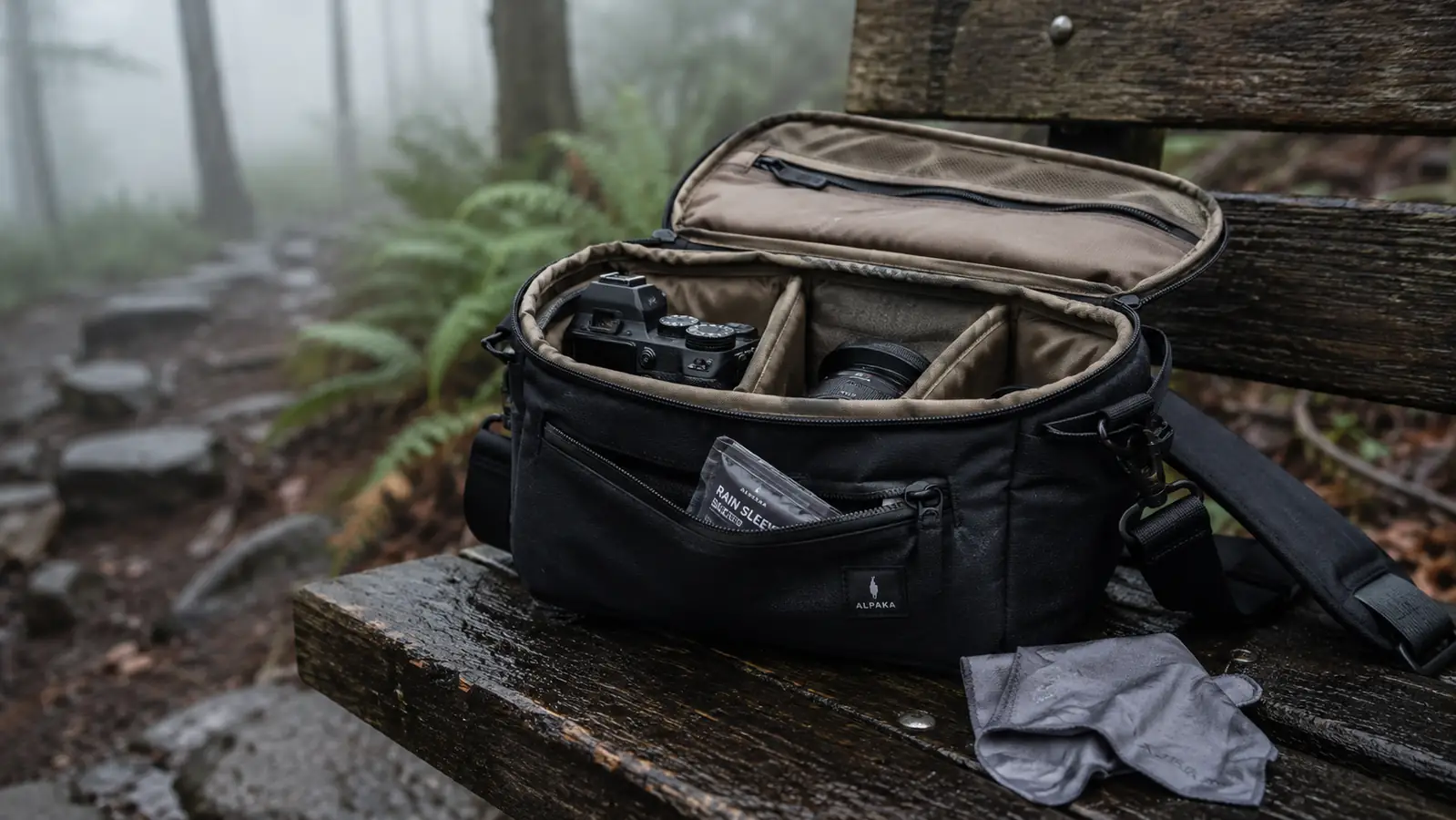
The listed weight is 27.22 grams. That is lighter than the lens cloth and the blower in the same pocket. Weight is the reason most weather gear stays home: a fitted jacket is another item to carry, another thing to dry, another decision. This is not that. It folds down small enough to disappear into the front pocket of my sling bag, and I forget it is there until I need it, which is the only test of gear that matters.
The small size covers the lens that stays on the camera
The small Rainsleeve is rated for camera and lens setups up to 4.5 inches in diameter and 8 inches long. My everyday zoom is a 24-105mm, and it fits with room to spare. The telephoto is a different story. A 70-300mm on the body is longer than the sleeve wants, so on bird mornings I either shoot the zoom or accept that the long lens stays in the bag when the rain gets serious. That is a real limit, and I would rather tell you now than have you find out at the trailhead.
You can still see and reach the controls through it
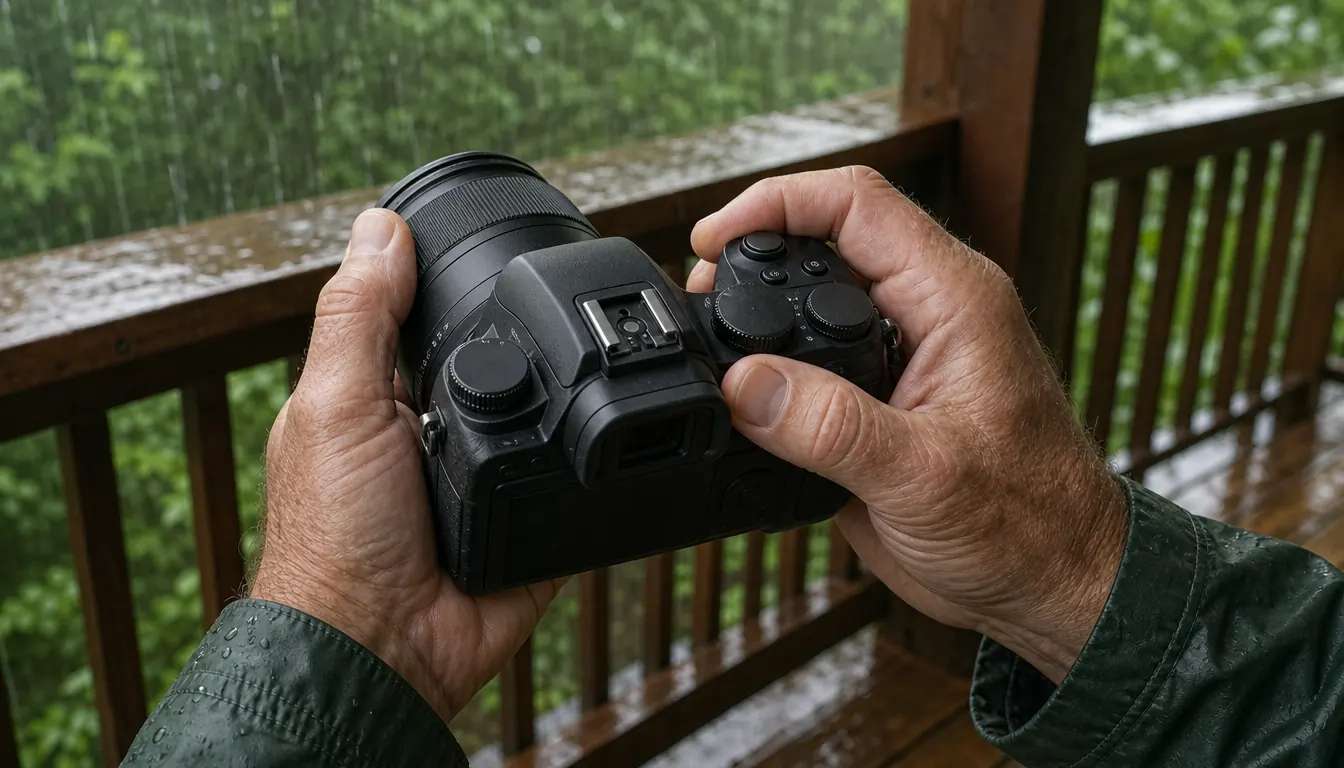
The material is clear, and OP/TECH USA lists full visibility of the controls as the reason for it. That sounds like a line from a listing until you try shooting with a bag over your camera and realize you cannot find the dial you need. With the sleeve on I can see the mode dial, the rear screen and the shutter, and I can change a setting without pulling the whole thing off. Most of the time I set the camera before it goes in. The times I have had to adjust, I could.
Viewfinder access means you shoot the way you normally do
The sleeve is cut for viewfinder access, so the camera stays at your eye instead of out at arm's length like a phone. That matters more than it sounds. Composing on the back screen in the rain means rain on the screen, and rain on the screen means a smear you cannot see through. Holding the camera the way I always hold it, eye to the finder, is the difference between the sleeve being an inconvenience and being invisible.
Two wet Saturdays at Rainbow Falls and one soaking at Onomea Bay on the same two sleeves, and they are still folded in the front pocket.
The two-pack puts one in the bag and one in the car
Two sleeves per pack sounds like a small thing until you leave one on the lanai railing to dry and drive to the trailhead without it. I keep one in the sling bag's front pocket and the second in the glovebox of the SUV. The one in the car has saved a Saturday twice now, once at Liliuokalani Gardens when the rain came off the bay with no warning at all. Two sleeves, one package, and I stopped having a single point of failure.
Waterfall spray and tide pool splash count as rain too
Nobody thinks of Onomea Bay as a rain problem until they are standing close enough to the surf to feel the mist on their face. Salt spray settles on a front element in a fine film, and it does the same to the body. The same sleeve that handles rain handles spray. I put it on before I walk down to the rocks, not after, and the front element stays clear enough that a wipe with the microfiber cloth gets me back to shooting.
Trade wind grit is the other half of the job
The listing calls it a rain and dust sleeve, and the dust half earns its keep at the Hilo Farmers Market. Trade winds move a lot of fine grit around, and a camera body with exposed dials collects it. I do not bother with the sleeve on a calm dry morning. On the windy ones I do, and I have stopped finding grit around the shutter button afterward. It is a small thing. Small things are the whole job with camera gear.
It removes the decision to pack up and go home
The value is not really the sleeve. It is the decision it takes off your plate. Without one, every dark cloud is a choice: keep going and risk the body, or pack up and lose the morning. With one in the pocket, the choice is already made. I have come home with usable frames from mornings I would otherwise have spent in the car watching the rain come across the bay, and that is worth more to me than the pocket space it takes.
A pocket of space against a repair bench
A wet camera body is a bench visit. A folded sleeve is a pocket. That is the trade, and it is not close. OP/TECH USA backs the Rainsleeve with a lifetime warranty against defects in materials and workmanship, which I have not had to use, and I like knowing it is there. Twenty two months in, mine has been folded, unfolded, rained on, dried on a lanai railing and folded again, and it still does the one thing I bought it for.
What I'd Skip
The honest limits, because a sleeve is not magic. It is water resistant, not a hard housing, and it will not save a camera that goes into the water. It flaps in a strong wind, which is annoying at the coast. Changing lenses under it is not practical, so pick a lens before the rain starts and commit to it. If you shoot in downpours for hours at a stretch, a fitted rain jacket is the better tool, and I say that without having owned one. If you never shoot in weather, skip all of this. The sleeve is for the person who already knows they will get caught out. For that person it is the piece of gear I have never once regretted carrying.
Twenty two months, one pocket, a dry camera
Two sleeves per pack, so one can live in the bag and one can live in the car.
Amazon Check today's price on Amazon →